
Drinking & Household Water
Water you drink, shower in, run through pipes, and brew with. Judged for health, taste and what it does to your plumbing.
This branch covers the water that arrives at your property and everything you do with it: drinking and cooking, yes, but also showering, the water sitting in your pipes overnight, and what goes into a coffee machine or kettle.
It is judged very differently from pool water. Nothing here is about sanitiser efficiency. The questions are whether anything present is a health risk, whether the water tastes and feels the way you want, and whether it is slowly damaging the plumbing it runs through.
Two of those are matters of preference and two are not. Hardness and total dissolved solids are largely about taste, appliance life and how soap behaves; there is a wide band of perfectly acceptable answers. Lead, nitrate, manganese and turbidity are health parameters with limits set by regulators, and those are not preferences.
Where a US federal limit exists we name it, because it is the number your utility is held to and the one a lab report will be measured against. WiseWaterGauge is a record-keeping and orientation tool, not a compliance service and not medical advice: if a health parameter is out of range, the next step is a certified laboratory test and your water utility's annual report, not a chemical from a shop.
What unbalanced water looks like
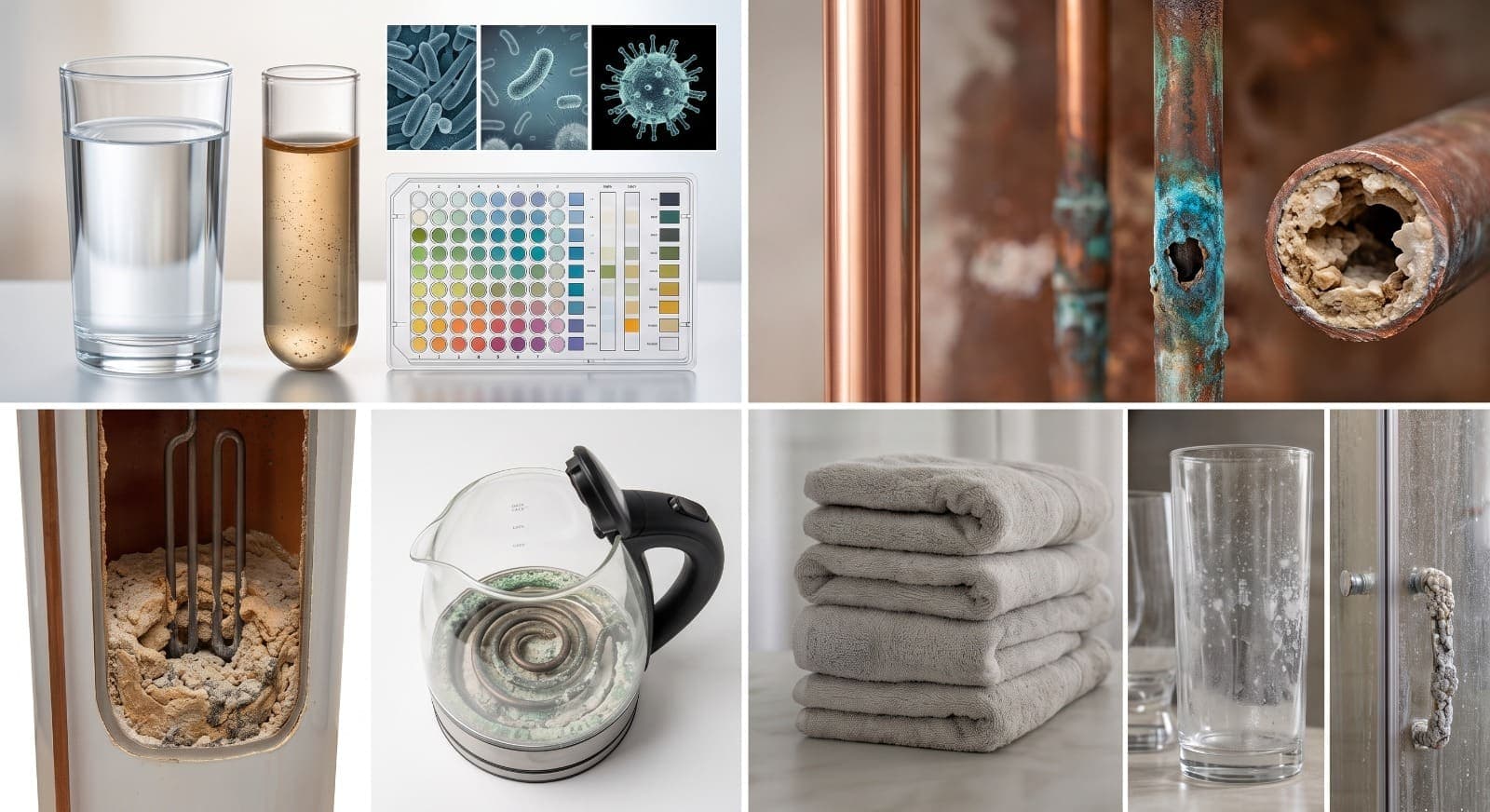
Household water rarely announces itself. It shows up as an appliance that died early, a shower screen you cannot keep clean, or nothing visible at all — which is why the readings matter more here than the look of the glass.
Brown, orange or cloudy at the tap
Iron and manganese stain everything they touch and are a nuisance rather than a health limit. Cloudiness is the one to take seriously: turbidity is what shields bacteria from disinfection.
Turbidity →Nothing you can see at all
Lead, nitrate and arsenic are colourless, odourless and tasteless at every level that matters. This is the entire argument for testing rather than judging by eye, and it is why a well needs a laboratory once a year.
Lead →Green corrosion and pinhole leaks in copper
Water that sits below its balance point dissolves the pipe it runs through. The copper ends up in the glass, and the leak arrives years before anybody expected to replumb.
Copper →Scale round the heater element and in the kettle
Hard water drops calcium onto the hottest surface it can find. A sediment bed under the element is a water heater running at a fraction of its efficiency and heading for an early failure.
Hardness →Stiff laundry, spotted glass, a filmed shower screen
Soap and hardness minerals combine into a curd that stays in the fabric and dries onto the glass. It is cosmetic, it is relentless, and it is the commonest reason somebody starts testing at all.
Total Dissolved Solids →Coliform in a sample
Bacteria indicate a path between the outside world and your water: a cracked well cap, a break in the main, a backflow. There is no safe amount, and the answer is never a filter.
Total Coliform →
Parameters
- pH6.5 – 9.5 pHHow acidic or basic your water is. Mostly a plumbing and taste question rather than a health one.
- Chlorine0.2 – 4 mg/LThe disinfectant your utility adds to keep water safe all the way to your tap.
- Hardness0 – 500 mg/LDissolved calcium and magnesium. Not a health issue, but it decides scale, soap and how your water feels.
- Lead0 – 0.015 mg/LThe parameter where the water leaving the treatment plant tells you nothing, because the lead comes from your own pipes.
- Nitrate0 – 10 mg/LA genuine health parameter with a hard regulatory limit, and the one that matters most for infants.
- Manganese0 – 0.05 mg/LA naturally occurring metal that stains everything black, and has a health limit lower than people expect.
- Iron0 – 0.3 mg/LOrange-brown staining, metallic taste, and the reason your laundry looks rusty.
- Turbidity0 – 1 NTUHow cloudy the water is, and, on a treated supply, a warning sign that disinfection may be compromised.
- Fluoride0 – 2 mg/LAdded in many supplies for dental health, and naturally present in some groundwater at higher levels.
- Total Alkalinity0 – 500 mg/LThe water's buffering capacity, quietly decisive for pipe corrosion and for how coffee tastes.
- Total Dissolved Solids0 – 1000 mg/LEverything dissolved in the water added together, a rough proxy for taste and mineral content.
- Arsenic0 – 0.01 mg/LA naturally occurring carcinogen with no taste, no smell and no colour. Wells are where it shows up.
- Copper0 – 1.3 mg/LAlmost always from your own pipes rather than the source, and the blue-green staining is the tell.
- Uranium0 – 0.03 mg/LA naturally occurring radioactive metal in groundwater. The kidney damage matters more than the radioactivity.
- Barium0 – 2 mg/LA naturally occurring metal with a comparatively generous limit. Rarely a problem, occasionally a surprise.
- Cadmium0 – 0.005 mg/LA kidney toxin that usually arrives from corroding galvanised pipe rather than from the ground.
- Chromium (Total)0 – 0.1 mg/LOne number covering two very different chemicals — one a nutrient, the other a carcinogen.
- Mercury0 – 0.002 mg/LRare in drinking water and serious when present. The form in water is not the form in fish.
- Selenium0 – 0.05 mg/LAn essential nutrient with a narrow margin. Too little is a dietary problem; too much in water is a real one.
- Antimony0 – 0.006 mg/LUncommon, and when it appears it usually came from a pipe, a solder joint or a plastic.
- Beryllium0 – 0.004 mg/LVery rare in drinking water. Its serious reputation comes from breathing it, not drinking it.
- Thallium0 – 0.002 mg/LRare, highly toxic, and one of the few metals whose health goal sits well below its legal limit.
- Aluminum0 – 0.2 mg/LOften added deliberately during treatment, and judged on appearance rather than on health.
- Zinc0 – 5 mg/LA nutrient, and a taste problem long before it is a health problem.
- Silver0 – 0.1 mg/LRare in tap water, and usually traceable to a filter that was sold as antimicrobial.
- Nitrite (as N)0 – 1 mg/LNitrate's short-lived cousin, with a much tighter limit and the same danger to infants.
- Chloride0 – 250 mg/LThe salty half of salt. Judged on taste, but it is also what corrodes your plumbing.
- Sulfate0 – 250 mg/LA bitter taste, a laxative effect on visitors, and the food that rotten-egg smells are made from.
- SodiumWorth knowing if you are on a restricted diet, and the number a water softener quietly raises.
- CalciumOne of the two minerals that make water hard, and a nutrient rather than a contaminant.
- MagnesiumThe other half of hardness. Contributes scale, a slight bitterness, and a laxative effect at high levels.
- PotassiumAlmost never a problem, and mostly of interest to people with kidney disease or a potassium-based softener.
- ConductivityHow well the water carries a current, which is a fast proxy for how much is dissolved in it.
- Hydrogen SulfideThe rotten-egg smell. Detectable by nose far below any level that matters to health.
- Total Chlorine0 – 4 mg/LFree chlorine plus what has already reacted. On a chloraminated supply, this is the number that counts.
- Total Coliform0 CFU/100 mLMostly harmless bacteria used as an indicator. Their presence means a path exists that should not.
- E. coli0 CFU/100 mLDirect evidence of faecal contamination. The one result on a water report that is an emergency.
By what you use it for
The same supply is a different question depending on what it is for.