
Water for Coffee & Espresso Machines
Why the same beans taste different on different water, and which numbers actually decide it.
Coffee is about 98% water, so the water is not a background detail; it is most of the drink. Two people using identical beans, grinder and machine can pull noticeably different shots purely because of what comes out of their taps.
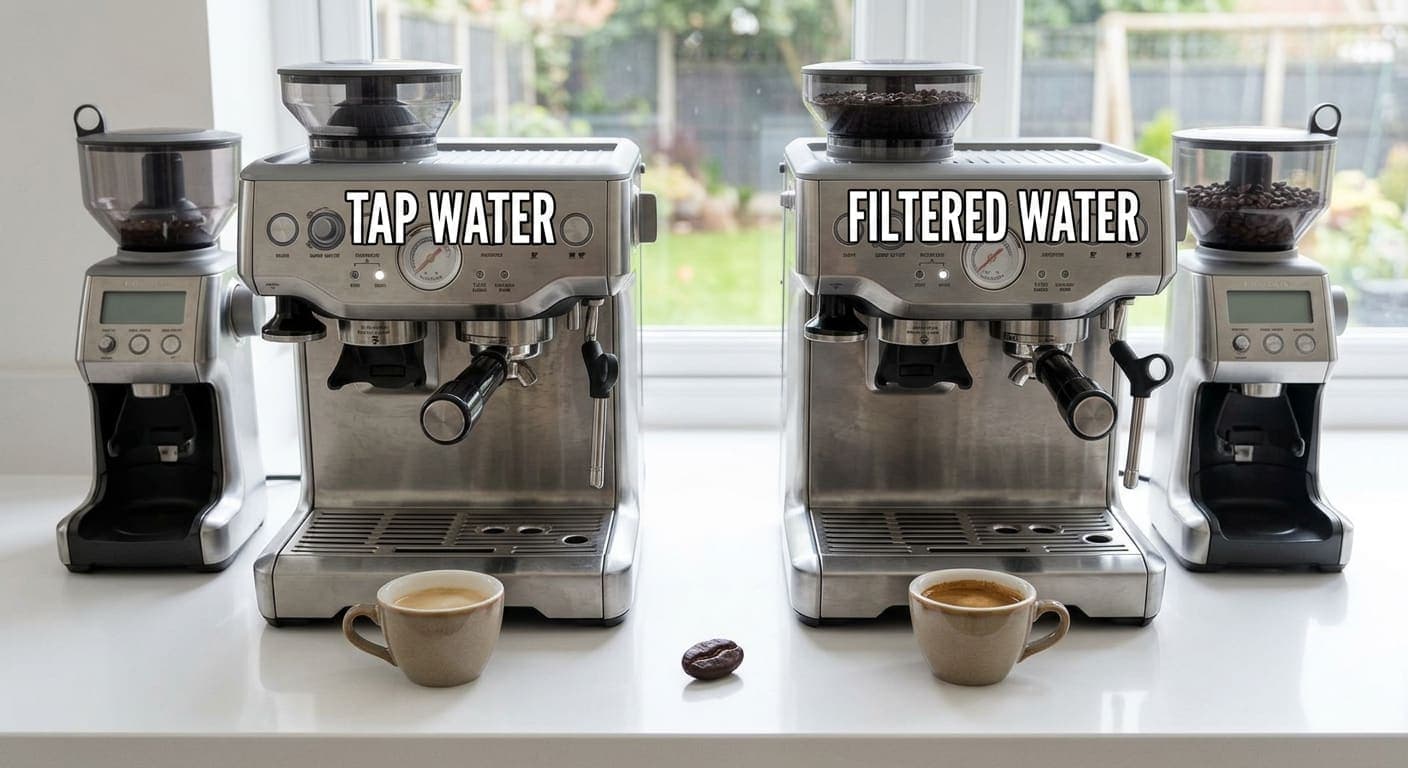
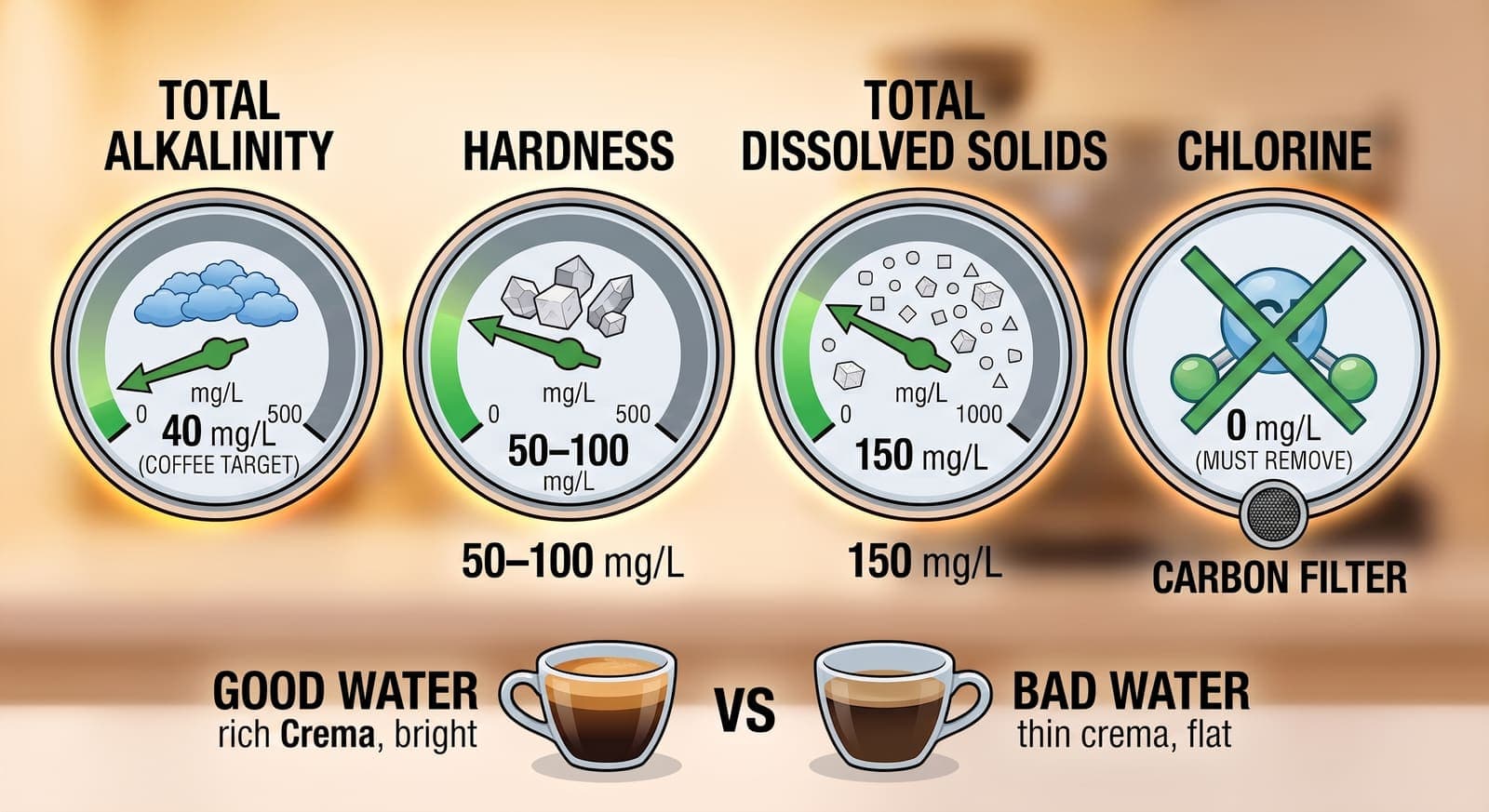
The number that matters most is the one people look at least: alkalinity. Coffee's flavour is carried substantially by its acids, and alkalinity neutralises them. High-alkalinity water flattens a coffee, muting brightness into something dull and faintly chalky. Very low alkalinity leaves it thin and sour. Speciality brewing guidance typically targets around 40 mg/L, which is well below most municipal supplies.
Hardness plays a second role, and it pulls in two directions. Calcium and magnesium help extract flavour compounds, so water stripped to near zero (straight reverse osmosis or distilled) makes weak, hollow coffee. But the same hardness is what destroys the machine, because heating hard water drives calcium out of solution and onto the heating element. This is why espresso machines fail on scale far more often than on any mechanical fault.
The practical consequence: neither tap water nor pure RO water is usually right. The common answer is RO or distilled water remineralised to a target, or a scale filter sized to your hardness and changed on schedule rather than when the machine complains.
The numbers to aim at
The Specialty Coffee Association publishes a water standard for brewing, and it is the closest thing the industry has to an agreed answer. Two columns, because they are used differently: the target is what to build toward if you are making water from scratch, and the acceptable range is what not to worry about if your supply already falls inside it.
| Parameter | Target | Acceptable |
|---|---|---|
| Total dissolved solidsEverything dissolved, added up. Useful for aiming, too blunt to tune with: the same 150 can be mostly bicarbonate or mostly magnesium, and those two taste nothing alike. | 150 mg/L | 75–250 mg/L |
| Calcium hardnessThe extraction mineral, and the scale mineral. Below this, coffee thins out; above it, the boiler pays. | 68 mg/L as CaCO₃ (4 grains) | 17–85 mg/L as CaCO₃ |
| Total alkalinityThe buffer that neutralises coffee's acids. The number most worth measuring and the one most likely to be too high on a municipal supply. | 40 mg/L as CaCO₃ | 40–70 mg/L as CaCO₃ |
| pHA consequence of the two rows above rather than something you set directly. | 7.0 | 6.5–7.5 |
| SodiumSmall amounts round out body. This is why softened water, which trades calcium for sodium, brews badly: the mineral that extracts has been removed and the one left behind does not replace it. | 10 mg/L | 0–30 mg/L |
| ChlorineThe one entry with no tolerance at all. It carries straight into the cup, and carbon filtration removes it. | 0 mg/L | 0 mg/L |
| Odour and colourQualitative, and still worth doing: smell the water before blaming the beans. | Clean and fresh, clear | No detectable odour, no turbidity |
Two cautions about the hardness row, because it is where published guidance disagrees with itself. Restatements of this standard circulate with an acceptable range of 50–175 mg/L instead of 17–85; both trace back to the same association, so treat the wide one as a tolerance and the narrow one as the aim. And a hardness figure means nothing without knowing how it is expressed: 68 mg/L as CaCO₃ is about 27 mg/L of actual calcium ion, and a magnesium-built water reporting 68 mg/L as CaCO₃ holds only about 17 mg/L of magnesium. Water reports and mineral recipes flip between the two conventions constantly, which is how people end up building water three times too hard.
Alkalinity and hardness pull in opposite directions
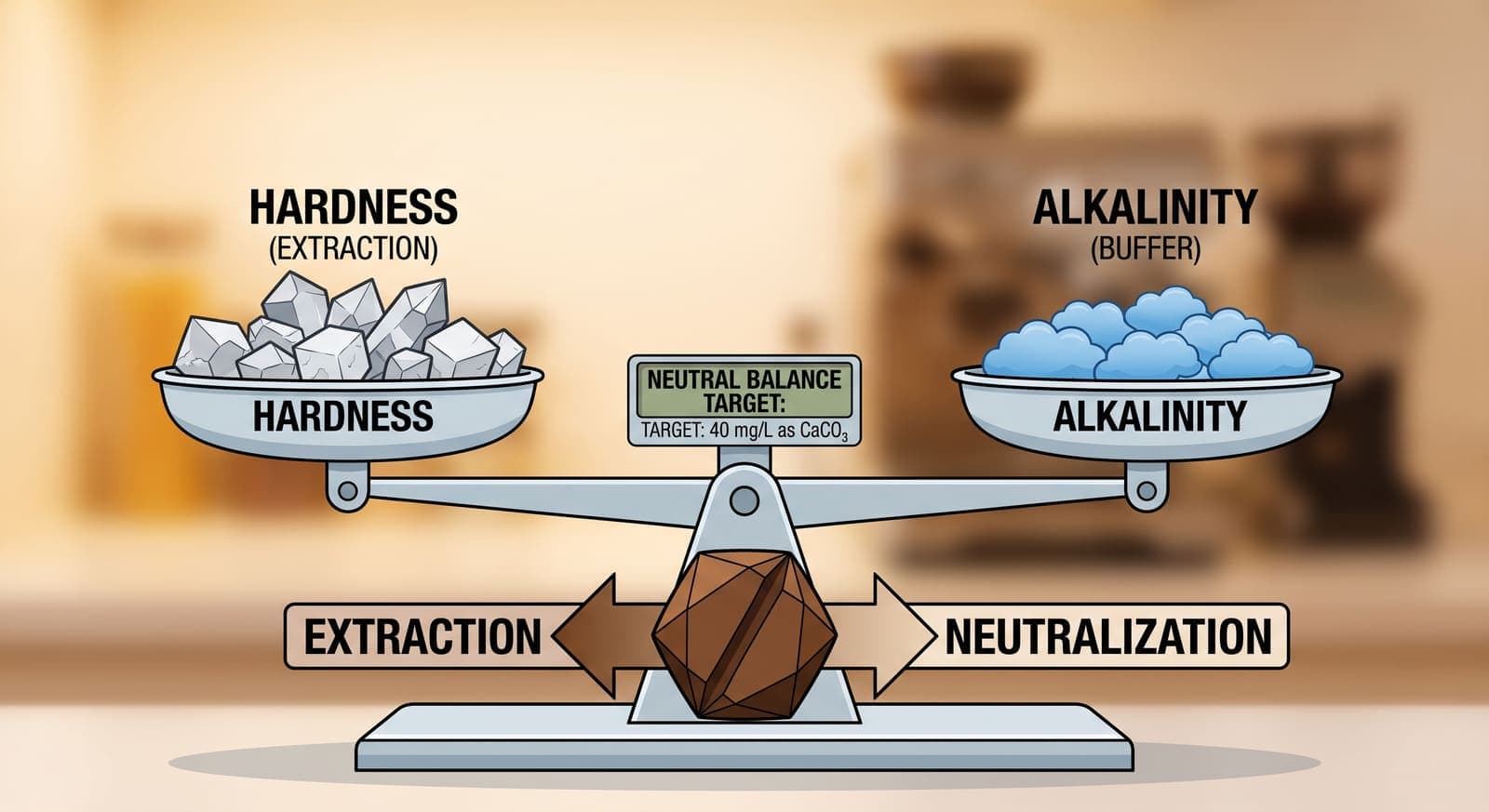
These two are measured on the same scale and are constantly confused, but they do opposite jobs in a cup of coffee. Hardness is the dissolved calcium and magnesium, the ions that grab flavour compounds out of the grounds. Alkalinity is mostly bicarbonate, the buffer that resists a change in pH, which in practice means it neutralises the acids the coffee is giving up.
So they are not two versions of one measurement. Hardness decides how much comes out of the coffee; alkalinity decides how much of what came out you can still taste. It is entirely possible to have water that extracts well and tastes flat, and that combination (high hardness, high alkalinity) is exactly what a lot of municipal supplies are.
This is also why the advice to soften water backfires. An ion-exchange softener does not reduce alkalinity; it swaps calcium and magnesium for sodium and leaves the bicarbonate where it was. You lose the extraction and keep the flattening, which is the worst of both.
Which minerals actually improve the cup
The useful research here is a 2014 paper in the Journal of Agricultural and Food Chemistry by Hendon, Colonna-Dashwood and Colonna-Dashwood, which modelled how dissolved cations bind to the flavour compounds in coffee. The finding that matters for anyone building water: magnesium is the strongest extractor of the three common cations, calcium is close behind with a preference for different compounds, and sodium contributes little to extraction.
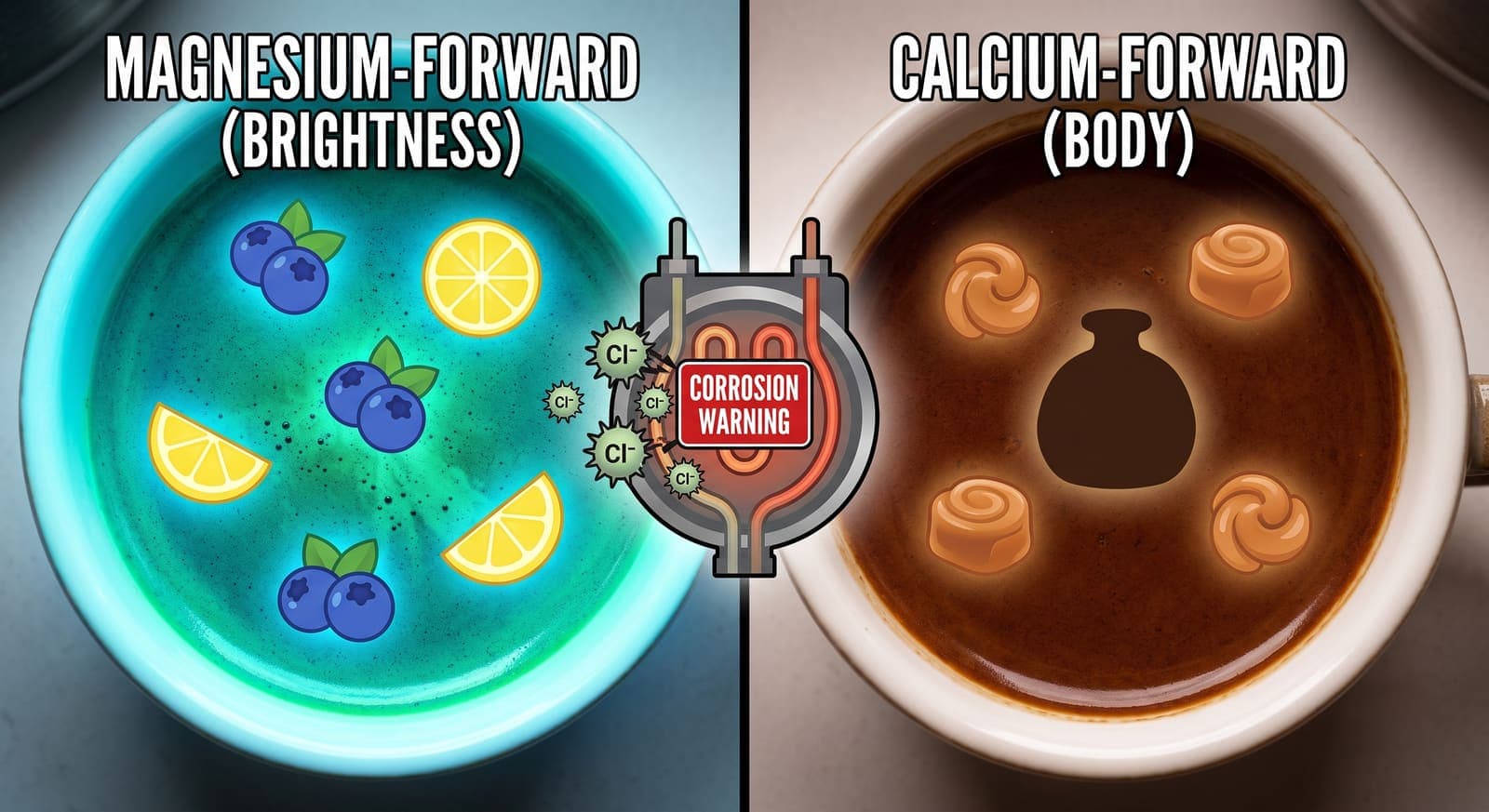
In tasting terms that maps onto something reproducible. Magnesium-forward water pushes brightness, fruit and acidity, the qualities a light roast is bought for. Calcium-forward water pulls toward body, sweetness and a rounder, heavier cup. Neither is correct; they are two ends of a dial, and cafés that take water seriously pick a point on it deliberately rather than inheriting whatever the mains delivers.
The anion matters too, and for a reason that has nothing to do with taste. Chloride accelerates corrosion of stainless steel under heat and pressure, which is the environment inside an espresso boiler. This is why coffee-specific mineral recipes reach for magnesium sulfate and potassium bicarbonate rather than the chloride salts, and why sea-salt-style additions are a bad idea in a machine you intend to keep.
Bicarbonate is the third ingredient and the one to add sparingly. Some buffering protects against a sour, harsh cup and stops the water being aggressive toward metal; too much is the flatness this whole page is about. Around 40 mg/L as CaCO₃ is where most brewing guidance lands.
How a global chain pours the same cup everywhere
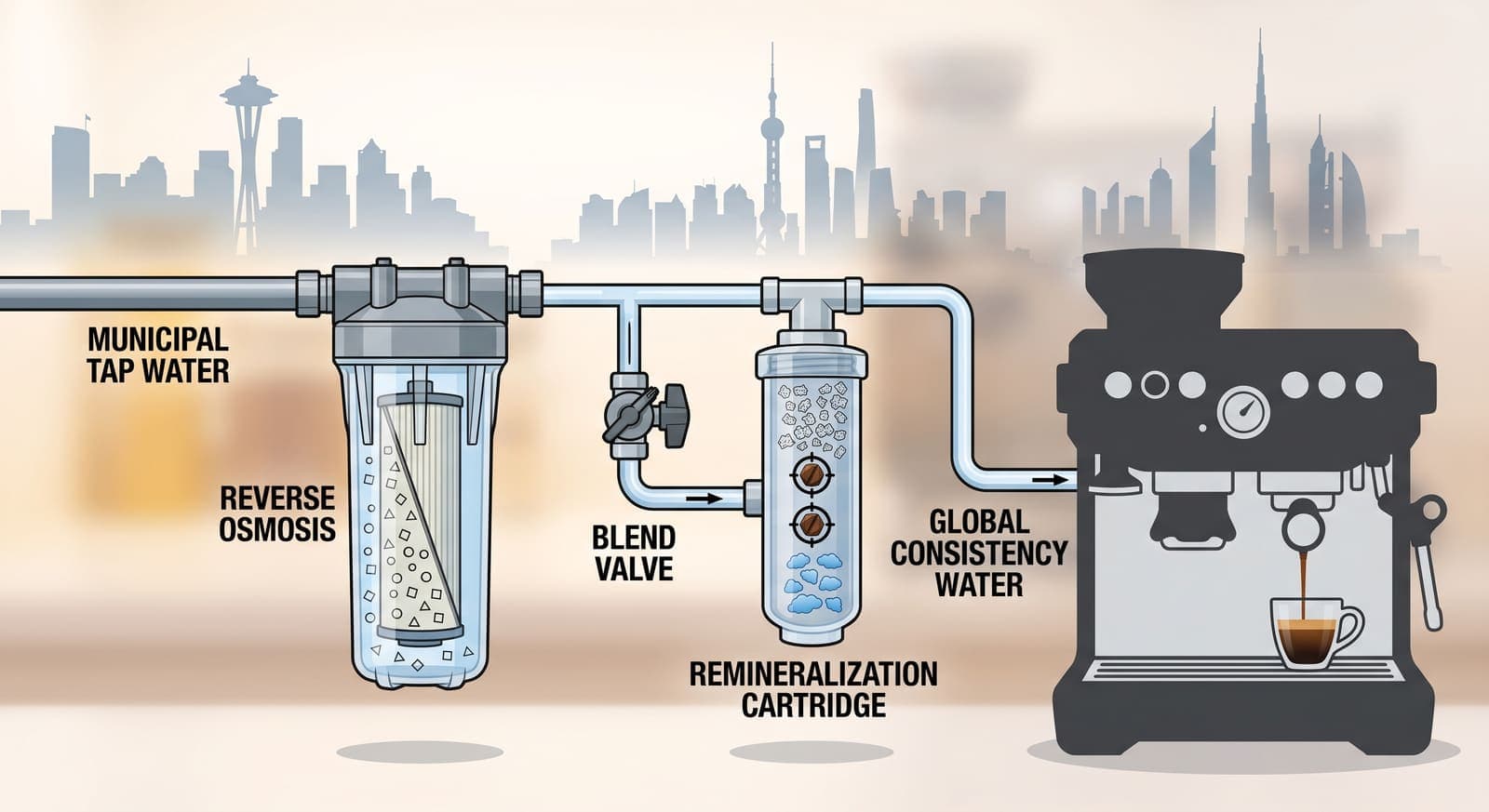
Starbucks is the usual example, and the answer is less exotic than people expect: they do not find good water in each city, they delete the local water entirely and rebuild it. Stores run a multi-stage filtration system ending in reverse osmosis: sediment first, then activated carbon for chlorine and taste, then a membrane that rejects the dissolved minerals themselves.
The point of that is consistency rather than purity. Municipal water in Seattle, Shanghai and Dubai differs enormously in hardness, alkalinity and disinfectant, and those differences would show up in the espresso as surely as changing the beans would. Reverse osmosis removes the variable. What arrives at the machine is nearly the same everywhere, whatever the city did upstream.
But pure RO water is not what brews the coffee, and it cannot be: it extracts poorly, it tastes hollow, and it is aggressive toward the machine. Commercial systems therefore add minerals back, by one of two standard routes: a blend valve that mixes a measured fraction of untreated water back into the permeate, or a cartridge the treated water passes through that redissolves a controlled amount of mineral. Either way the operator sets a number and the equipment holds it.
Starbucks has not published its own specification, so the exact target is not a matter of public record and this page will not invent one. What is documented is the shape of the approach, and the shape is the transferable part: strip the water to a blank, add back a fixed mineral profile, and the last uncontrolled variable in the drink is gone. The same logic explains the rest of the chain's consistency (fixed grind, fixed dose, fixed ratio, automated machines), and the water is simply the ingredient that is easiest to forget and hardest to notice going wrong.
Building your own water, and the arithmetic behind the recipes
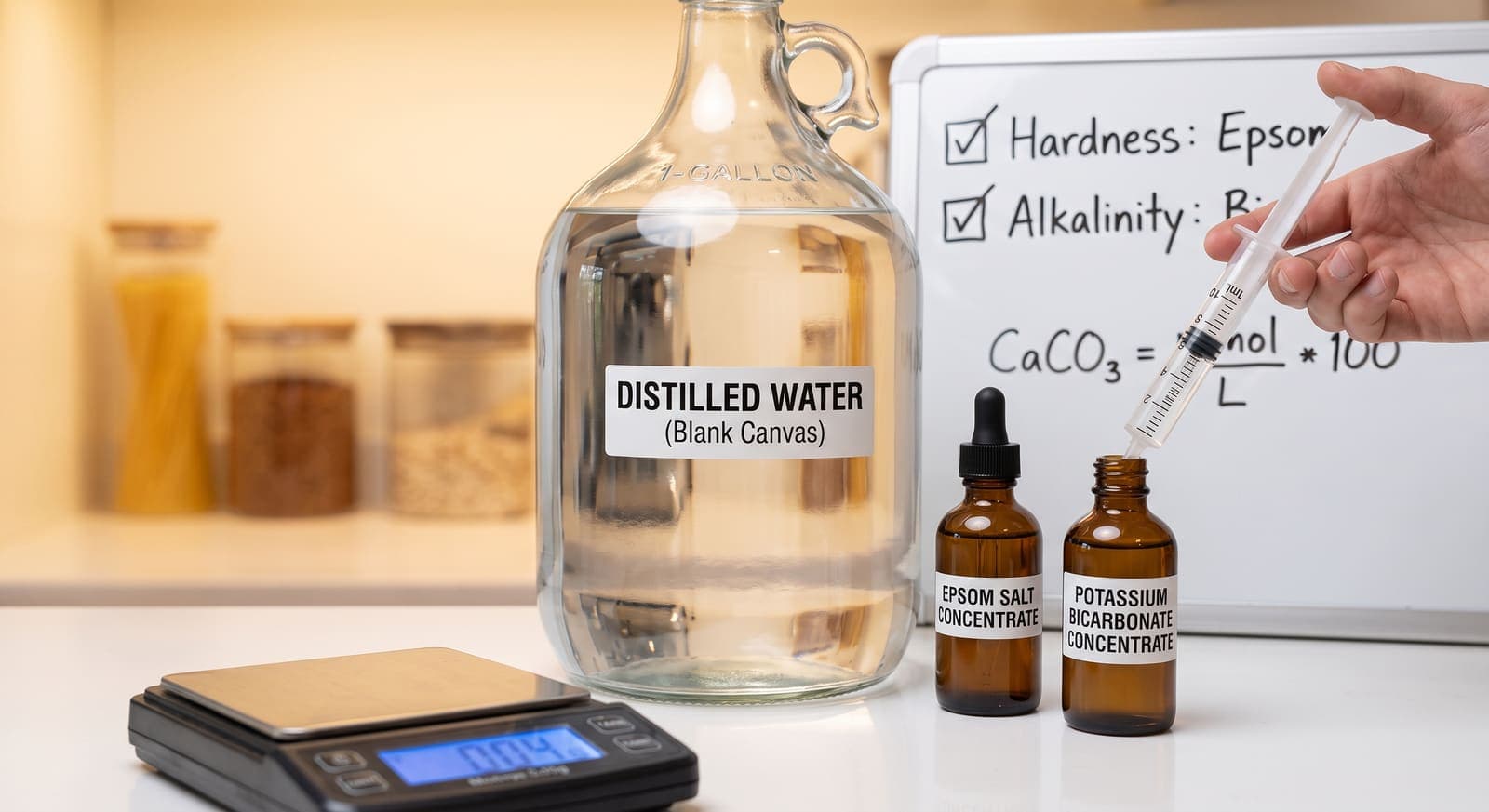
If your supply is far from the table above, the reliable fix is to stop treating it as water and start treating it as a recipe: begin with distilled or RO water, which has essentially nothing in it, and add a known quantity of two salts. Magnesium sulfate heptahydrate (Epsom salt) supplies the extraction mineral. Potassium bicarbonate supplies the buffer, and is preferred to sodium bicarbonate because it leaves no sodium behind.
The arithmetic is worth showing, because published recipes disagree wildly and most of the disagreement is unit confusion rather than genuine dispute. Hardness and alkalinity expressed 'as CaCO₃' are just millimoles per litre multiplied by 100. So 0.68 mmol/L of magnesium is 68 mg/L as CaCO₃ (the SCA target), and one millimole of Epsom salt weighs 246 mg, which puts the dose at about 0.17 g per litre. For alkalinity, 40 mg/L as CaCO₃ is 0.40 mmol/L, and potassium bicarbonate weighs 100 mg per millimole, so about 0.04 g per litre. Any recipe you find can be checked the same way in under a minute.
In practice nobody weighs 40 milligrams accurately at home, so the usual method is a concentrate: dissolve a hundred times those amounts in one litre, keep it in the fridge, and dose 10 mL into each litre of distilled water. Commercial sachets are the same idea sold pre-measured.
Two warnings before pouring anything into a machine. Never add mineral concentrate to a machine's internal reservoir or boiler directly; it must be dissolved in the full volume of water first, or you will deposit exactly the scale you were trying to avoid. And some espresso machines with automatic fill use conductivity to detect the water level: pure RO or distilled water can read as no water at all, and the machine will either refuse to fill or run its pump dry. Remineralised water solves that, but it is worth knowing the failure exists before you meet it at six in the morning.
The numbers that decide it
Common questions
Should I use distilled water in my coffee machine?
Not on its own. Distilled water has essentially no minerals, and some mineral content is needed to extract flavour properly; the result tastes hollow. It can also be aggressive toward some machine components. Remineralised distilled or RO water is the usual approach where scale is a serious concern.
What water hardness is best for espresso?
Broadly 50–100 mg/L, with alkalinity nearer 40 mg/L. That is enough mineral content to extract well without scaling the boiler quickly. Most tap water is harder than this, which is why filtration is common in cafés.
Why does my coffee taste flat even with good beans?
High alkalinity is the most likely explanation. It neutralises the acidity that carries brightness and fruit, flattening everything into a dull, slightly chalky cup. Testing alkalinity is worth doing before buying a better grinder.
How does Starbucks get the same coffee in every country?
By removing the local water rather than adapting to it. Stores filter through sediment and carbon and then reverse osmosis, which strips the dissolved minerals that vary from city to city, and minerals are added back, either by blending a measured fraction of untreated water into the output, or through a cartridge that redissolves a controlled amount. The specification itself has never been published, so the exact target is not public; the approach is what transfers. Pure RO water on its own would not work, because it extracts poorly and is aggressive toward the machine.
Which minerals should I add to water to make coffee taste better?
Magnesium and calcium for extraction, and a small amount of bicarbonate as a buffer. A 2014 study in the Journal of Agricultural and Food Chemistry found magnesium to be the strongest extractor of the common cations, with calcium close behind but favouring different compounds: magnesium-forward water tastes brighter and fruitier, calcium-forward water rounder and heavier. Sodium adds little. Use magnesium sulfate (Epsom salt) and potassium bicarbonate rather than chloride salts: chloride corrodes stainless steel boilers under heat and pressure.
How much Epsom salt and bicarbonate per litre?
About 0.17 g of Epsom salt and 0.04 g of potassium bicarbonate per litre of distilled or RO water gets you close to the SCA targets, roughly 68 mg/L hardness and 40 mg/L alkalinity, both as CaCO₃. The arithmetic is simple enough to check: as CaCO₃ is millimoles per litre times 100, Epsom salt weighs 246 mg per millimole and potassium bicarbonate 100 mg. Weighing 40 mg accurately at home is unrealistic, so make a 100× concentrate and dose 10 mL per litre.
Is bottled water good for coffee?
Some is, and the label tells you before you buy. Compare its numbers against the table above: the ones that brew well sit near 150 mg/L total dissolved solids with low bicarbonate, and mineral waters sold on their mineral content are usually far too hard and too alkaline. Distilled and reverse-osmosis bottled water is the opposite problem and needs minerals added.
WiseWaterGauge helps you record and understand your own readings. It is not a substitute for a certified laboratory test, and nothing here is medical or regulatory advice.