
Distilled, RO & Deionized Water
How distillation, reverse osmosis and deionization each strip water down, what each one leaves behind, and why all three test acidic once they meet air.
Distillation, reverse osmosis and deionization all aim at the same result by different means: water with almost nothing dissolved in it. Distillation boils water and condenses the steam, leaving dissolved solids behind in the flask. Reverse osmosis forces water through a membrane fine enough to exclude most of them. Deionization passes water through ion-exchange resin, which swaps every dissolved mineral ion for the hydrogen and hydroxide that simply recombine into more water. The three are not interchangeable, because each one is blind to something different.
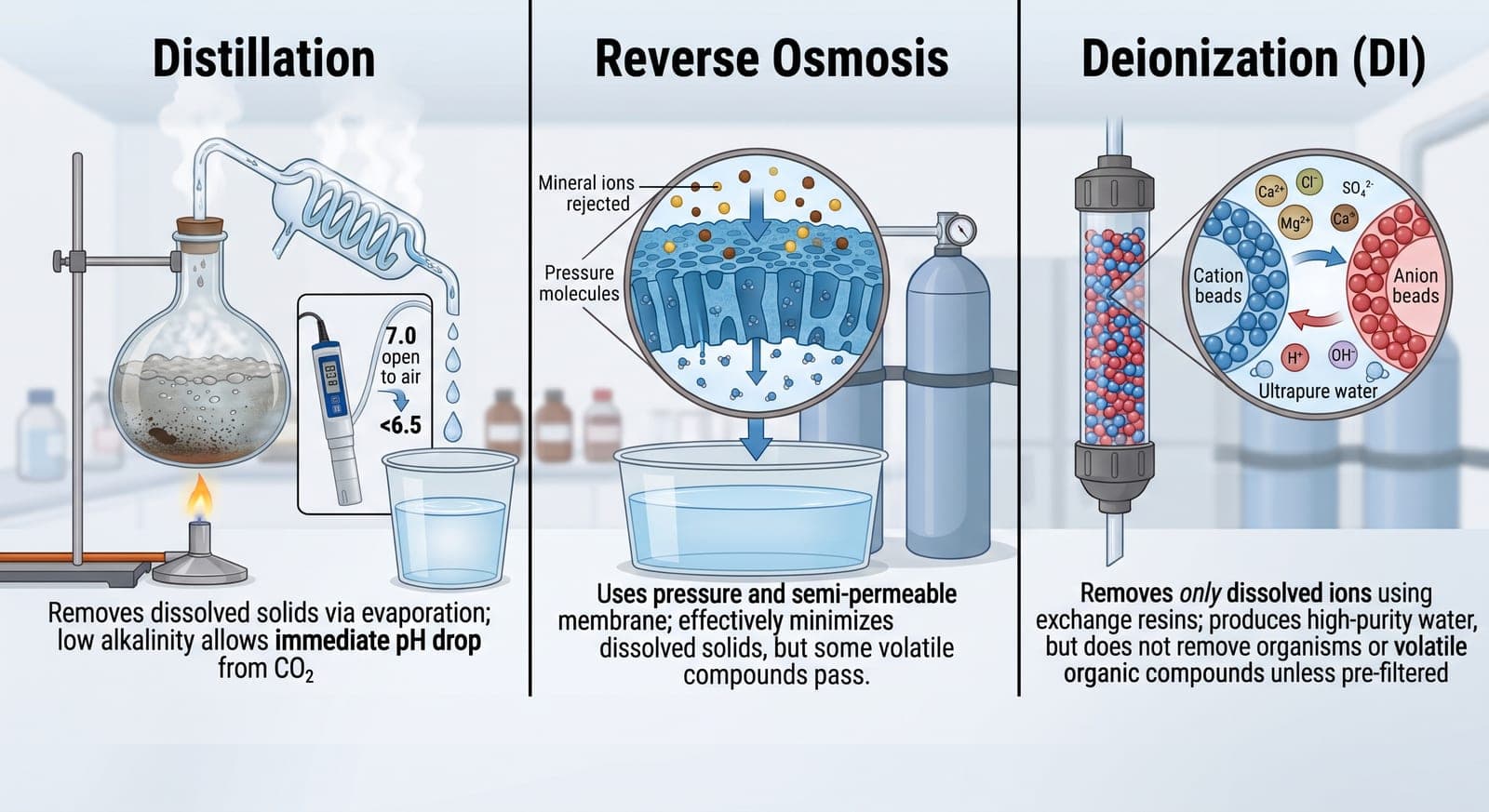
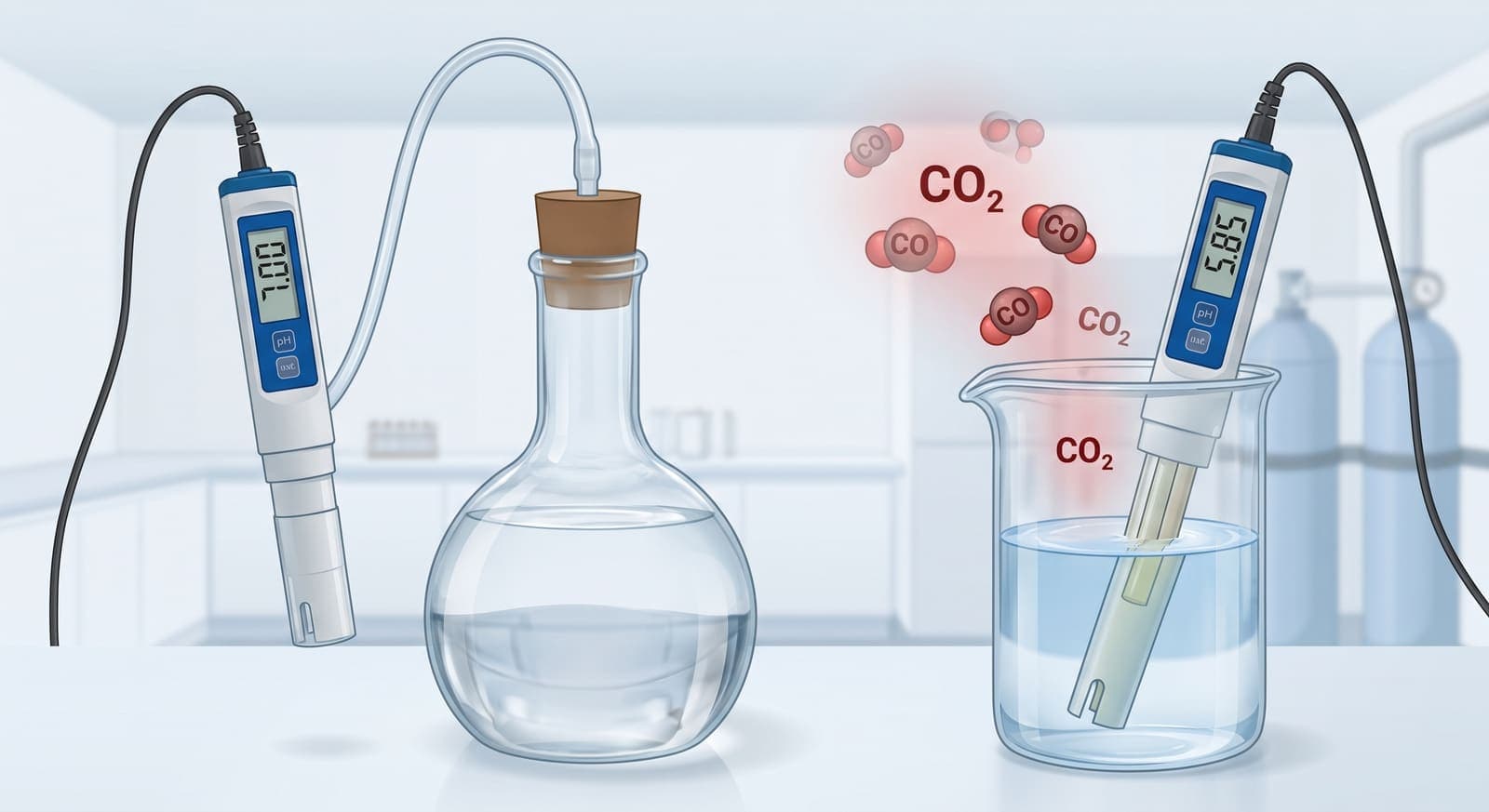
The most common surprise is that distilled water does not test at pH 7. Pure water is neutral at 7.0 the instant it is made, but it does not stay there: exposed to air, it absorbs carbon dioxide, which forms carbonic acid and pulls the reading down to roughly 5.5–6.5. This is not contamination and not a fault in the still. It happens because distilled water has essentially no alkalinity: with no buffering capacity, even a trace of dissolved CO₂ moves the pH substantially. It is the clearest practical demonstration of what alkalinity actually does.
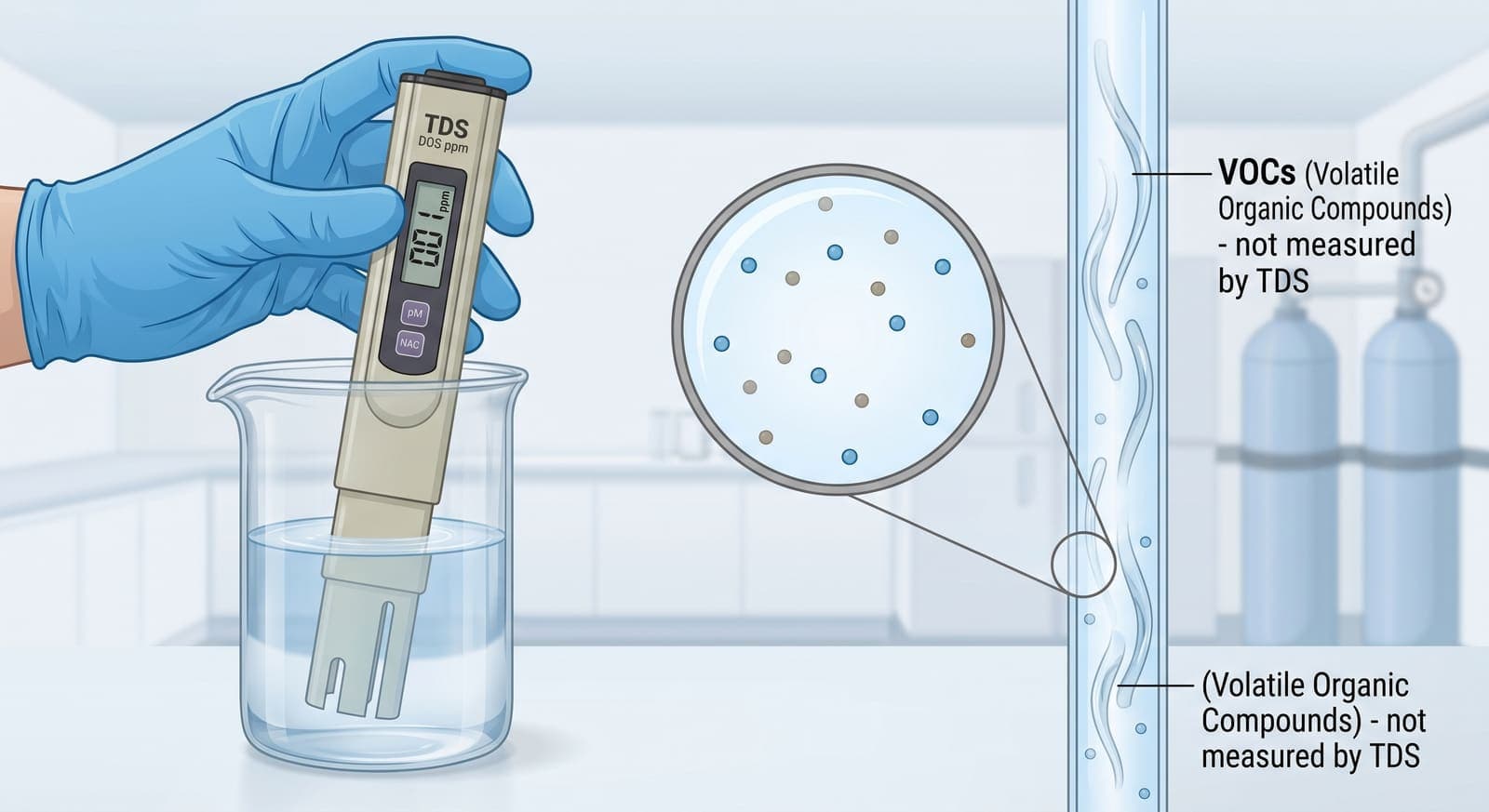
This also makes TDS meters misleading here. Distilled water reads near zero, which people take as proof of purity, but TDS only measures dissolved solids, and distillation carries over some volatile organic compounds along with the steam. Near-zero TDS means very few dissolved minerals; it does not mean nothing is present.
Purified water is genuinely the right choice for some uses: steam irons, CPAP machines, car batteries, laboratory work, and topping up appliances where scale is the enemy. As everyday drinking water it is a matter of preference: it is safe, it tastes flat to most people because the minerals that give water character are gone, and the mineral loss is not nutritionally significant next to food.
The three methods, side by side
Distillation is the most thorough of the three and the slowest. Boiling leaves behind dissolved solids and kills organisms, so the output is clean in more than one sense. Its blind spot is anything that boils at or below the temperature of water: volatile organic compounds travel over with the steam and condense into the finished product, which is why a still is not automatically the right answer for organic contamination.
Reverse osmosis is the one most people actually have under a sink. Pressure drives water through a semi-permeable membrane that rejects the large majority of dissolved solids, and unlike a resin it needs no regeneration, only replacement. It rejects contaminants by size and charge rather than absolutely, so performance varies by contaminant, and some small uncharged molecules pass. It also discards water: a household unit sends a share of what it takes in to the drain as concentrate.
Deionization removes only ions, and that word is doing all the work. Ion-exchange resin captures charged species — calcium, magnesium, chloride, sulphate — and gives back hydrogen and hydroxide, which combine into water. It does nothing whatever about uncharged organic molecules, bacteria or particulates, so DI is normally placed after a filter or an RO stage rather than used alone. The resin also exhausts, and an exhausted bed does not fail politely: it stops exchanging and can release what it previously captured, which is why DI systems are monitored continuously rather than checked occasionally.
The practical ranking is not a single line. For the lowest ionic content, deionization wins and is what laboratories reach for. For the broadest removal in one step, distillation wins. For everyday household use, reverse osmosis wins on effort and running cost. Purity is not one axis, and a method's headline number usually describes the axis it is best on.
One thing is true of all three, and it is the point the rest of this page is about: strip the minerals out and the alkalinity goes with them. Water with no buffering capacity cannot hold its pH against the carbon dioxide in an ordinary room, so distilled, RO and DI water all drift acidic on contact with air. DI water is the sharpest illustration — it can be the purest of the three by electrical measurement and still tell you nothing about whether an organism or a solvent is present.
The numbers that decide it
Common questions
Why is distilled water acidic?
Because it absorbs carbon dioxide from the air, forming carbonic acid. Freshly distilled water is pH 7.0, but on standing it typically settles between 5.5 and 6.5. With no alkalinity to buffer it, even a trace of dissolved CO₂ shifts the reading; the drop is expected rather than a sign of contamination.
Is it safe to drink distilled water?
Yes. It is safe to drink, though most people find it tastes flat because the dissolved minerals that give water character have been removed. The mineral content of drinking water is minor compared with diet, so the loss is not nutritionally significant.
Is reverse osmosis the same as distilled?
Not quite. Both produce water with very little dissolved content, but by different mechanisms: RO filters through a membrane, distillation evaporates and condenses. They differ in what slips through: distillation can carry over some volatile organics with the steam, while RO membranes reject most dissolved solids but vary by contaminant.
Is deionized water the same as distilled?
No, and the difference matters. Deionization removes dissolved ions on an exchange resin and leaves everything uncharged exactly where it was — organic molecules, bacteria, particulates. Distillation boils and condenses, which removes dissolved solids and organisms alike but carries some volatile organics over with the steam. DI water can measure purer than distilled while being less clean, because the measurement counts ions and the contamination is not ionic.
Can you drink deionized water?
Deionization itself does not make water unsafe, but it does not make it safe either: it removes no bacteria and no organic contamination, so DI water is only as clean as whatever treated it beforehand. Laboratory and industrial DI is not produced or handled as drinking water and should not be treated as such. Like distilled and RO water it also tastes flat, since the minerals that give water character are the ones the resin removes first.
WiseWaterGauge helps you record and understand your own readings. It is not a substitute for a certified laboratory test, and nothing here is medical or regulatory advice.