
Water for Black Tea
Why the same teabag makes a different cup in London and Manchester, what the film on the surface actually is, and how the British tea industry solved it by changing the tea rather than the water.
Black tea is the drink where water announces itself. Brew the same bag in soft water and in hard, side by side, and the difference is visible before you taste anything: one cup is bright, coppery and clear, the other darker, duller and often carrying a thin film across the surface. Nothing has changed but the calcium.
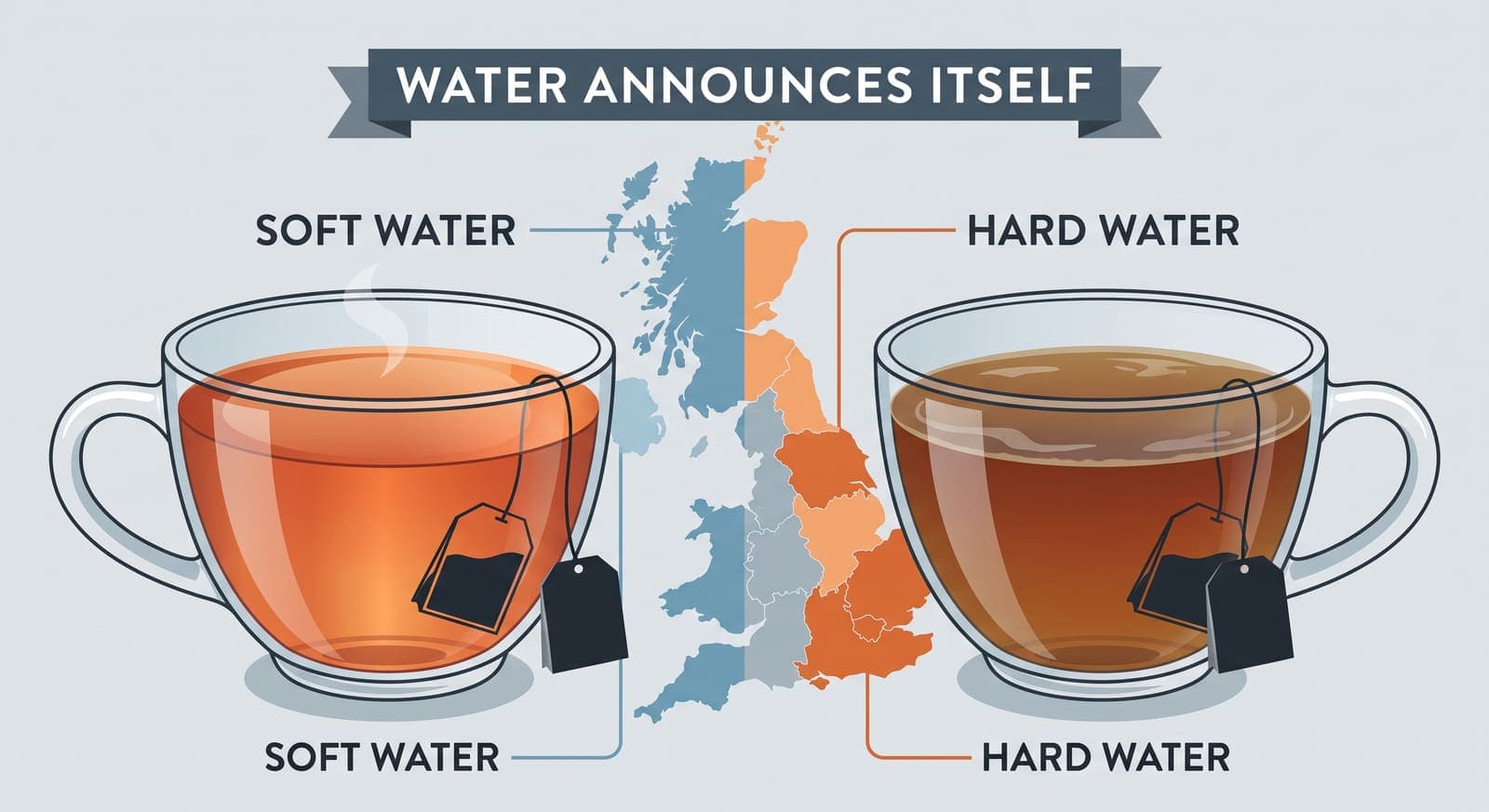
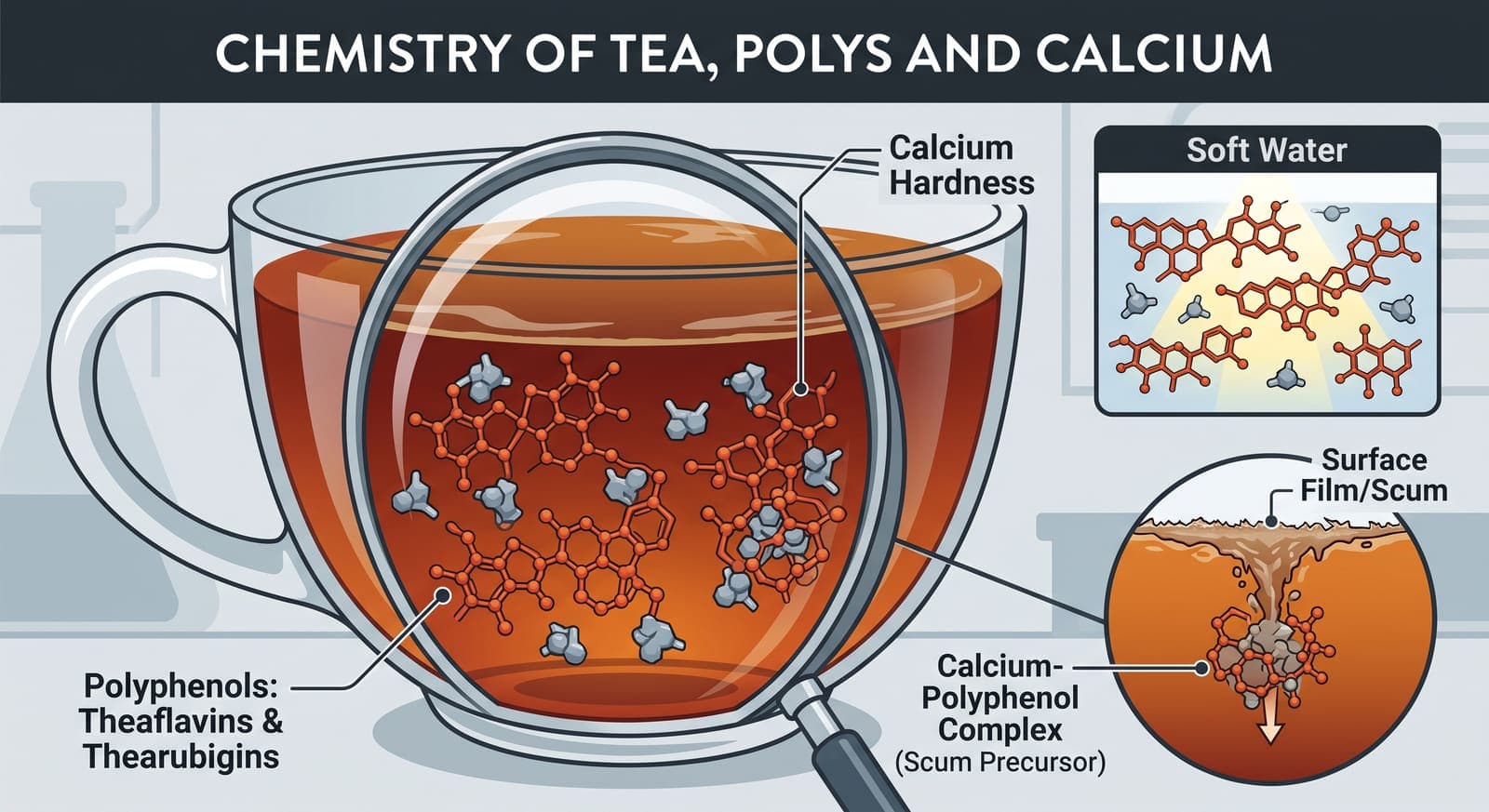
The reason is that black tea is fully oxidised, and oxidation is what produces the large polyphenols (theaflavins and thearubigins) that give it colour and briskness. Those molecules are exactly the ones that bind dissolved calcium. In hard water they complex, precipitate, and drop out of the flavour of the cup while darkening its appearance, which is the odd combination people report as tea that looks strong and tastes of nothing.
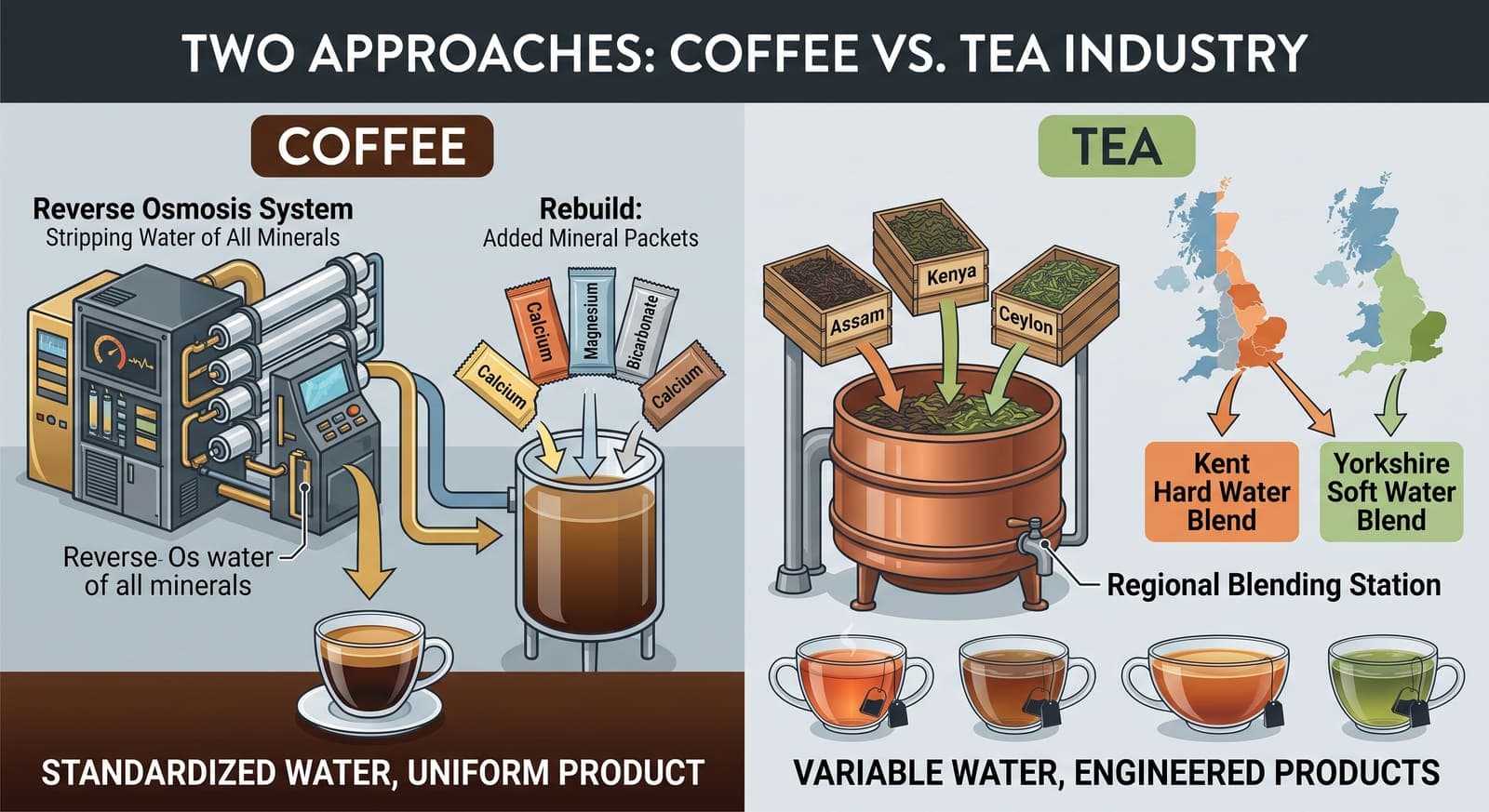
This is also the one brewing problem in this section with a genuine industrial answer, and it is not the answer coffee reached for. Coffee shops strip the water and rebuild it. The British tea trade did the opposite: it left the water alone and reformulated the tea, region by region.
The numbers to aim at
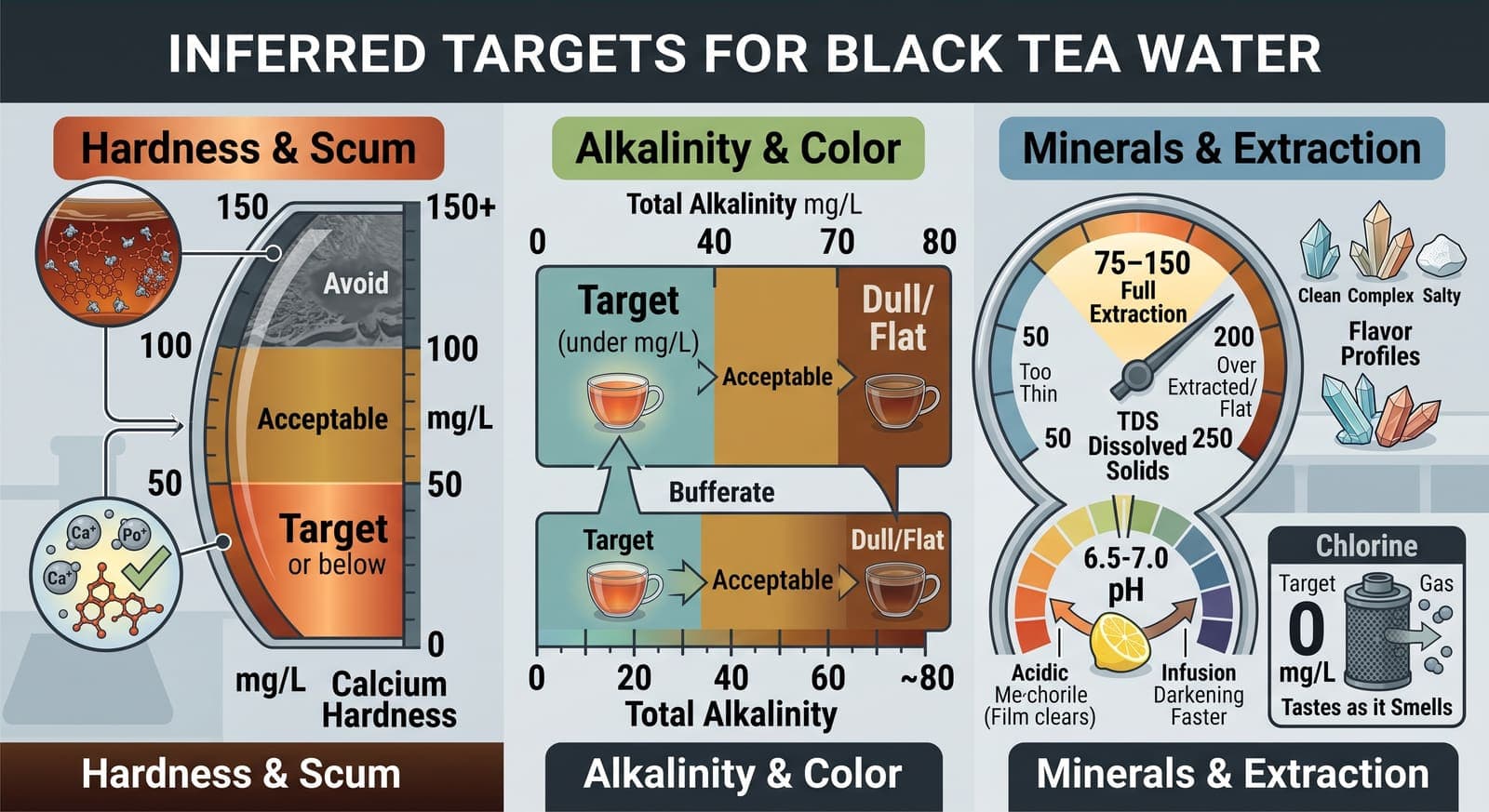
Tea has no equivalent of coffee's SCA standard (no trade body publishes a target table), so these are inferred from the published research on scum formation and infusion chemistry, and from what the water is in the places black tea is blended for. Treat them as direction rather than as a specification, which is why the notes say where each one comes from.
| Parameter | Target | Acceptable |
|---|---|---|
| Calcium hardnessThe single number that decides both the film and the flatness. Scum formation rises with calcium and disappears entirely in ultrapure water, so this is a dial rather than a threshold: less calcium, less film. | 50 mg/L as CaCO₃ or below | up to about 100 mg/L as CaCO₃ |
| Total alkalinityBicarbonate pushes the infusion alkaline, which accelerates the oxidation that both dulls the colour and forms the surface film. Same buffer, same problem as coffee. | under 40 mg/L as CaCO₃ | under 70 mg/L as CaCO₃ |
| Total dissolved solidsSome mineral content extracts better than none: tea brewed in distilled water is clean but thin, in the same way espresso is. The composition matters more than the total. | 75–150 mg/L | 50–200 mg/L |
| pHFollows from the two rows above. Above roughly pH 7 the infusion darkens faster; a squeeze of lemon takes it the other way and visibly clears the film. | around 7 | 6.5–7.5 |
| ChlorineTastes exactly as it smells, and no brewing decision recovers from it. Carbon filtration removes it. | 0 mg/L | 0 mg/L |
One target you will see quoted and should ignore: there is no meaningful ideal for magnesium in black tea specifically. The research that separates magnesium from calcium was done on coffee extraction, and applying its conclusions here would be borrowing a number from a different drink, which this page would rather say than quietly do.
The film on the surface is chemistry, not dirt
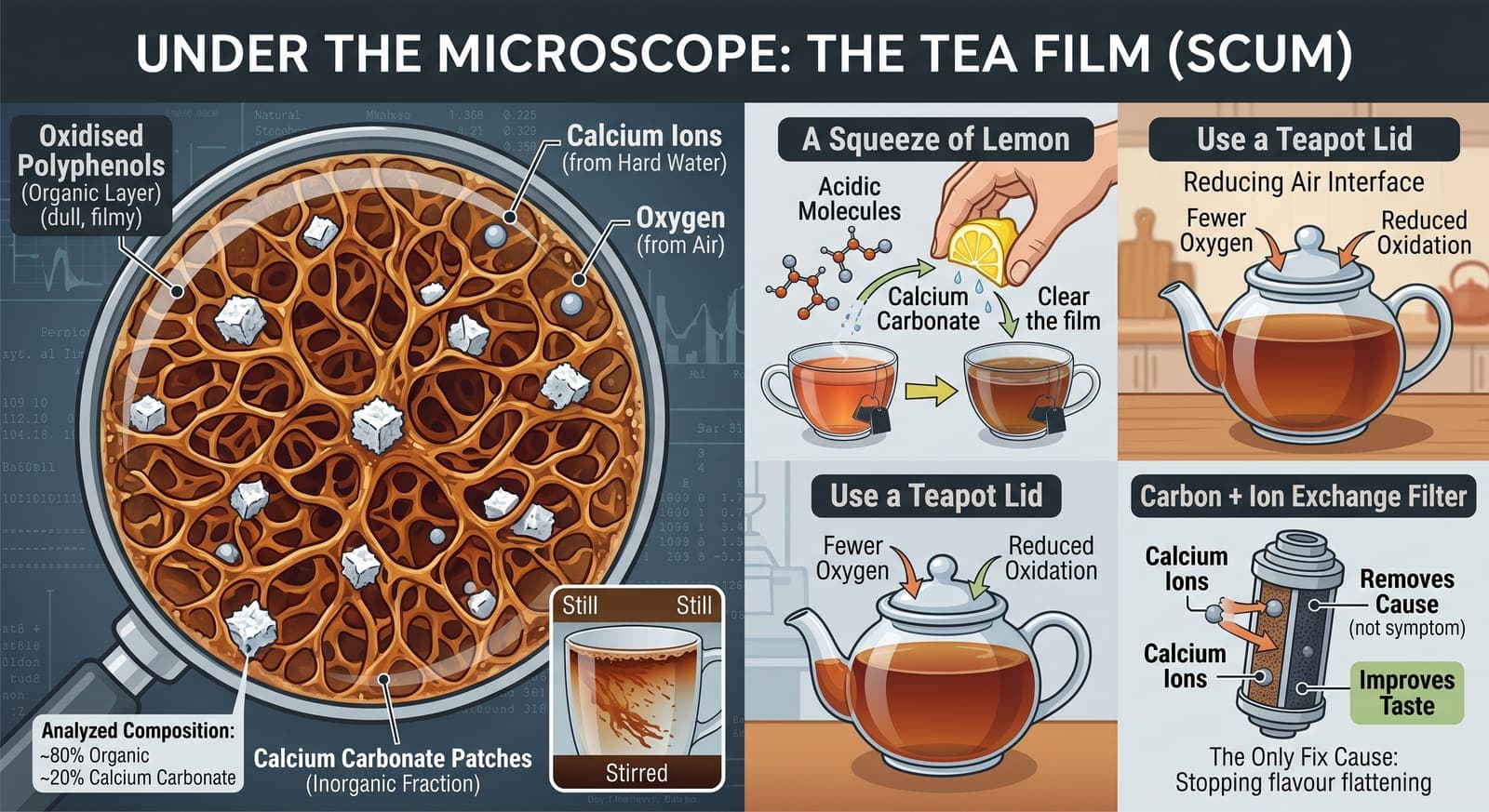
Tea scum was studied properly in the early 1990s, when a tea manufacturer put the question to Michael Spiro and Deogratius Jaganyi at Imperial College. Under an electron microscope the film turned out to be an organic layer (oxidised polyphenols) carrying small white patches of calcium carbonate through it, with published analyses putting the calcium carbonate fraction at roughly a fifth of the whole.
Two conditions are needed, and both explain something people notice. It needs calcium, which is why the film is a hard-water phenomenon and why brewing the same tea in ultrapure laboratory water produces no perceptible film at all. And it forms at the surface, where the infusion meets air, which is why it appears as a skin on a still cup rather than as sediment, and why stirring breaks it up into the streaks left around the inside of a mug.
The practical consequences follow directly. Acid dissolves the carbonate, so a squeeze of lemon clears the film and prevents it forming, a trick that predates the explanation by a century. A lid on the pot reduces the air interface. And filtering the calcium out removes the cause rather than the symptom, which is the only fix that also improves the taste, since the same calcium binding is what flattened the flavour in the first place.
How the British tea industry gets it right every time
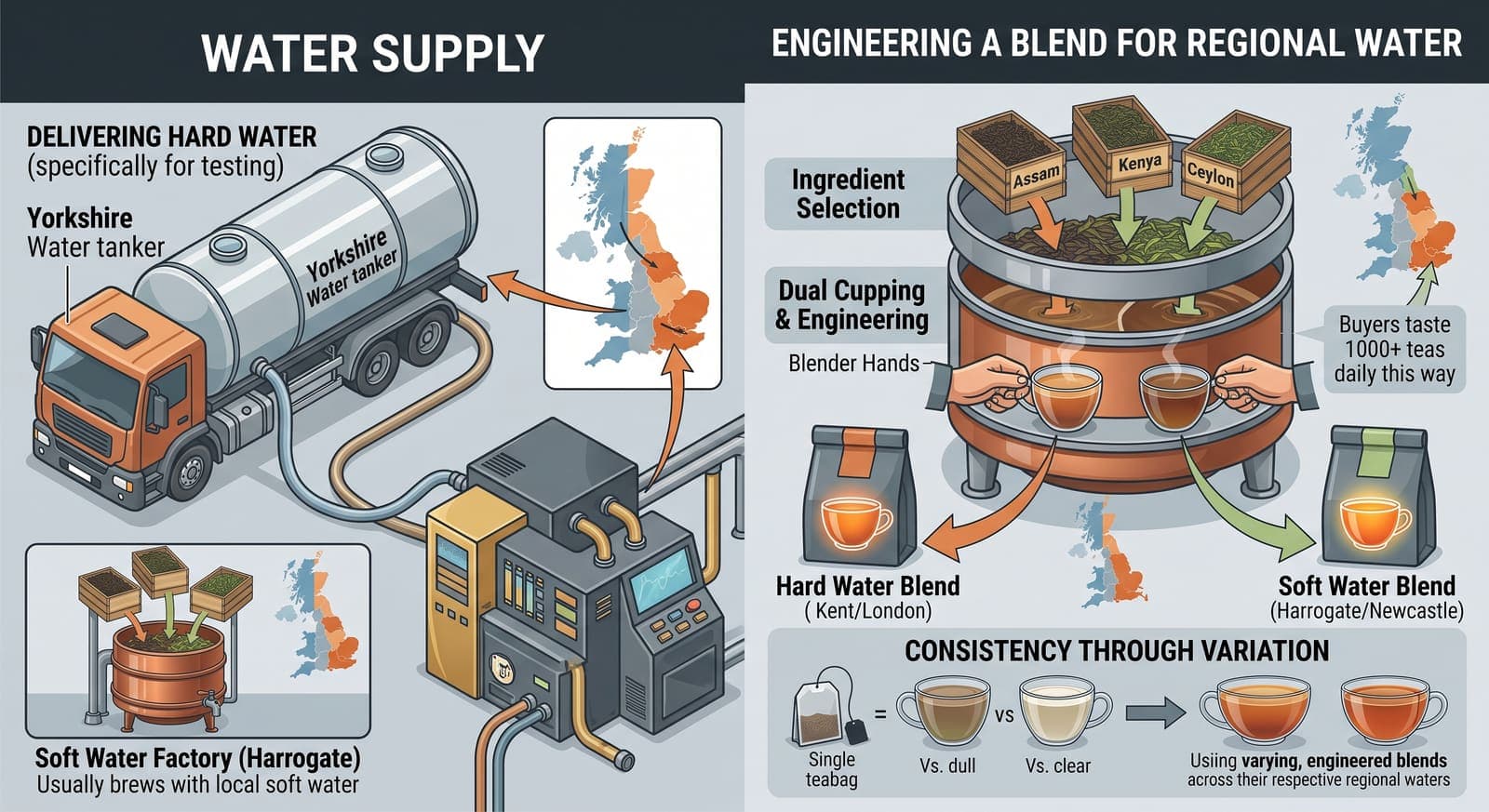
Britain is split down the middle by geology. The east and south sit on chalk and limestone and have hard water; the west and north are largely soft. That is not a minor regional variation; it is the difference between a cup that looks and tastes as the blender intended and one that does not, using an identical bag.
Taylors of Harrogate, who make Yorkshire Tea, describe their answer openly, and it is the opposite of the coffee industry's. Harrogate is a soft-water town, so their tea buyers cannot taste hard-water performance by accident. Yorkshire Water delivers tankers of its hardest water to the factory specifically so that every candidate tea can be tasted twice (once brewed soft, once brewed hard) before it goes into a blend. Buyers taste on the order of a thousand teas a day on that basis.
The result is that the blend itself is engineered for the water it will meet. They sell a separate Hard Water blend, adjusted so that a cup made in Kent behaves like a cup made in Yorkshire. Consistency across regions is achieved by varying the product, not by treating the supply.
That difference is worth sitting with, because it explains why domestic advice differs between the two drinks. A café can install reverse osmosis and standardise its water because it controls one site and one machine. A tea company cannot install anything in a million kitchens, so it moves the only variable it does control. Which means: if you are drinking a mass-market blend in a hard-water area, the blend has probably already compensated, and if you then soften or filter your water aggressively, you may be brewing a hard-water blend in soft water and wondering why it tastes thin.
What to change at home, in order
Start with chlorine, because it is the cheapest fix and the most obvious in the cup: a carbon filter jug or an inline carbon cartridge removes it in one step and changes nothing else about the water.
Then reduce calcium and bicarbonate if your supply is hard. A standard filter jug does some of this and exhausts quickly; a plumbed carbon-plus-ion-exchange cartridge does it consistently. Full softening is the wrong tool: it swaps calcium for sodium, which stops the film but leaves you with water that extracts poorly and tastes faintly saline. As on the coffee page, the reliable route where the supply is extreme is reverse osmosis with a controlled amount of mineral added back.
Then the traditional rules, which turn out to be about oxygen and temperature rather than superstition. Draw fresh water rather than reboiling what has sat in the kettle; use it at a full boil for black tea, unlike green; and warm the pot so the water does not lose 10°C on contact. These are small effects individually, and free.

The numbers that decide it
Common questions
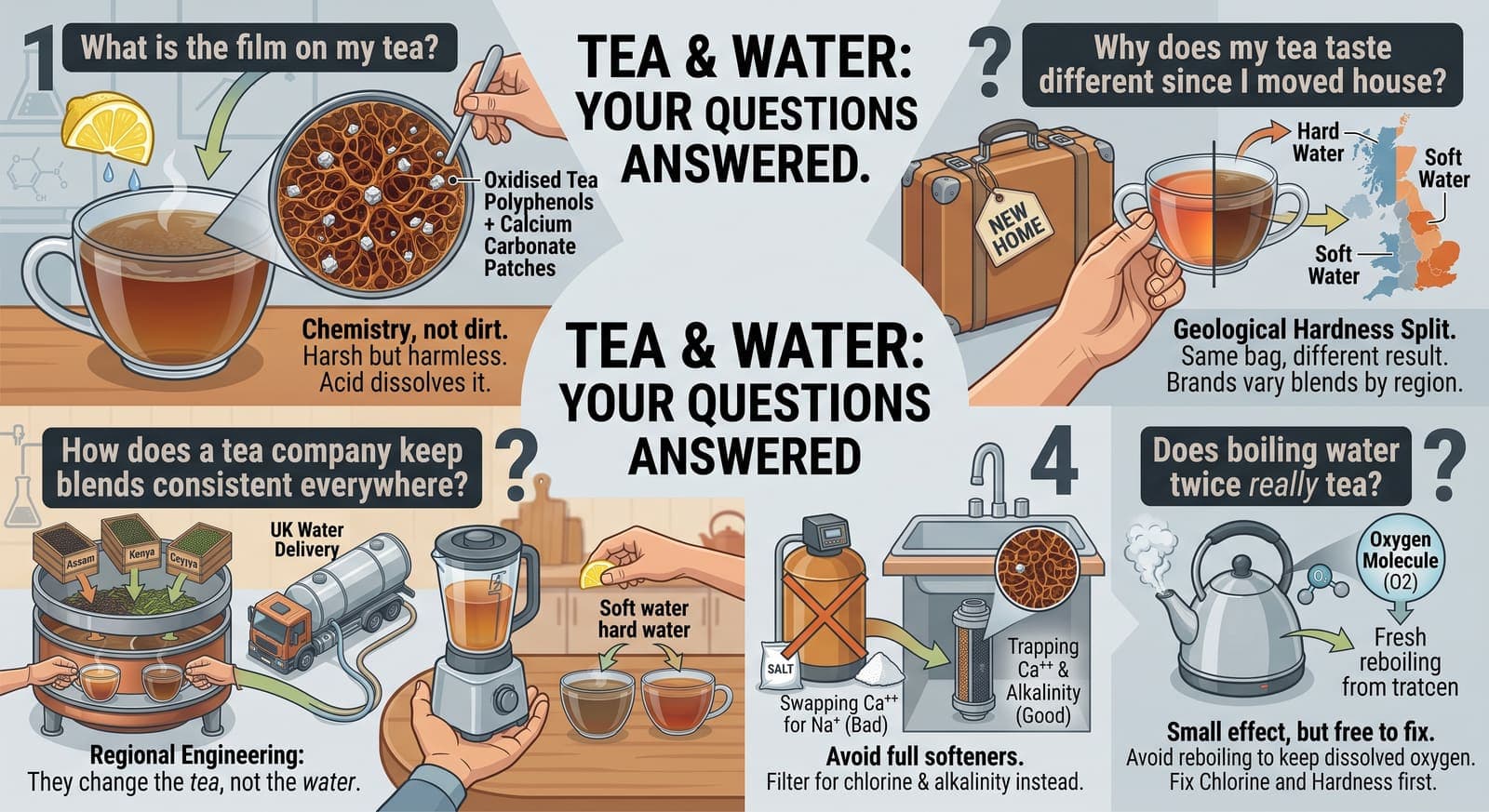
What is the film on the top of my tea?
Oxidised tea polyphenols with calcium carbonate distributed through them; roughly a fifth of it is calcium carbonate by published analyses. It needs dissolved calcium and an air interface, which is why it is a hard-water phenomenon, forms as a skin on a still cup, and does not appear at all in ultrapure water. It is harmless. A squeeze of lemon dissolves it, and filtering the calcium out prevents it.
Why does my tea taste different since I moved house?
Almost certainly water hardness. Britain and most other countries are split geologically between hard and soft supplies, and the same teabag brewed in each produces visibly and noticeably different cups: darker and duller in hard water, brighter and cleaner in soft. Blends are often formulated for one or the other, so moving between regions can also mean your usual brand is now the wrong version of itself.
How does a tea company keep a blend tasting the same everywhere?
By changing the tea rather than the water. Taylors of Harrogate have their water utility deliver tankers of hard water to their soft-water factory so buyers can taste every candidate tea brewed both ways, and they sell a separate blend formulated for hard-water regions. It is the reverse of the coffee industry's approach, which is to strip the local water with reverse osmosis and rebuild it; a café controls its own plumbing, a tea company cannot.
Should I soften my water for tea?
Not with an ion-exchange softener. It removes the calcium that causes the film, but replaces it with sodium and leaves the bicarbonate untouched, so you lose extraction and keep the flattening. Carbon filtration for chlorine, then a cartridge that reduces hardness and alkalinity together, is the better order. Where the supply is extremely hard, reverse osmosis with minerals added back is the same answer as for espresso.
Does boiling water twice really matter?
A little, and it is free to avoid. Reboiled water has lost dissolved gas, and the usual explanation for the flatter cup is that lost oxygen. The effect is small next to hardness and chlorine, so fix those first, but drawing fresh water costs nothing, which is why the rule survived.
WiseWaterGauge helps you record and understand your own readings. It is not a substitute for a certified laboratory test, and nothing here is medical or regulatory advice.