
Water for Green Tea
Green tea is the one that degrades rather than just tasting different: hard, alkaline water measurably destroys its catechins and browns the cup. What the research shows, and what Chinese and Japanese practice has said for twelve centuries.
Green tea is unoxidised, and that is the whole difference. Black tea arrives at the cup with its polyphenols already converted into the large, stable molecules that give it colour; green tea arrives with them intact as catechins (EGCG, EGC and their relatives) which are what give it its fresh, vegetal, slightly astringent character, and which are chemically fragile.
So where hard water changes black tea, hard water destroys green tea. It is not a matter of taste preference: the compounds are measurably fewer by the time the cup reaches you, and the infusion browns while it sits.
This is why the traditional advice from the two cultures that mastered green tea is so uncompromising about water, and why it has been consistent since long before anyone could measure a catechin.
The numbers to aim at
As with black tea there is no published standard, but green tea has better experimental grounding than any other use case on this site: a 2021 study in Molecules brewed identical green tea across five water hardnesses and measured what survived. These targets come from that work and from Japanese brewing guidance.
| Parameter | Target | Acceptable |
|---|---|---|
| Calcium hardnessSoft, and deliberately softer than for black tea or coffee. In the study, going from very soft to very hard water cut total catechins from 164.6 to 67.5 mg per cup, a 2.4-fold loss, with EGCG and EGC down more than threefold. | 20–40 mg/L as CaCO₃ | under about 60 mg/L as CaCO₃ |
| Total alkalinityThe active ingredient in the damage. Bicarbonate makes the infusion alkaline, and alkaline conditions autoxidise EGC and EGCG into brown polymers. The study identifies a browning threshold above roughly pH 6.3 and 42 mg/L as CaCO₃. | under 40 mg/L as CaCO₃ | under 50 mg/L as CaCO₃ |
| Total dissolved solidsJapanese brewing guidance for green tea, and lower than the coffee target for the same reason the hardness is: less to bind the compounds you are trying to keep. | 50–150 mg/L | 30–180 mg/L |
| pHSlightly acidic is safer than slightly alkaline here, which is the reverse of most drinking-water advice. Alkaline water is what browns the infusion. | 6.5–7.0 | 6.0–7.5 |
| ChlorineGreen tea's flavours are delicate enough that chlorine does not merely add a taste, it covers the ones you brewed the tea for. | 0 mg/L | 0 mg/L |
| Water temperatureNot a water-quality parameter, but the other half of the answer and the most common mistake: boiling water scalds green tea, extracting bitterness and destroying the aromatics. Gyokuro goes lower still. | 70–80°C | 60–85°C by style |
A caution about reading the study's numbers as a promise. It measured catechin content, not flavour, and total catechins are not the same thing as a good cup; the same softness that preserves EGCG also thins body. What the numbers establish firmly is the direction and roughly where the cliff is; the last adjustment is still made by tasting.
What hard water actually does to green tea
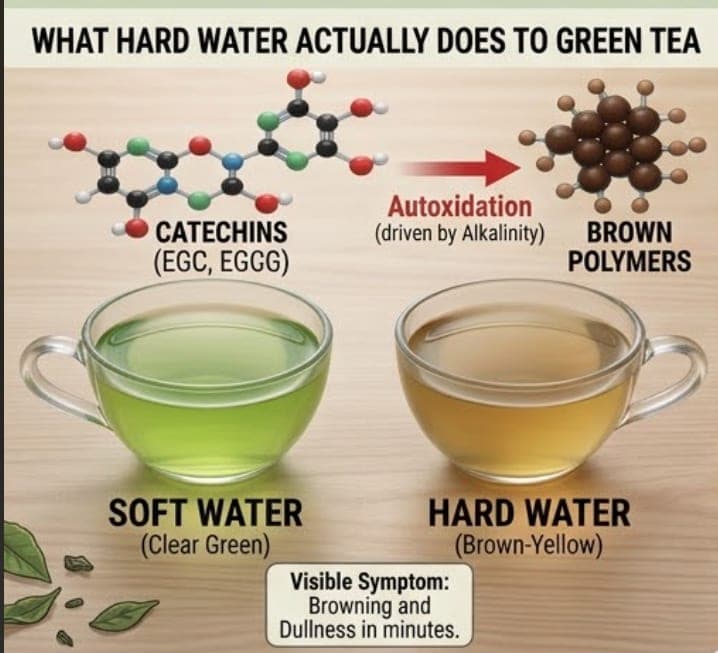
The 2021 study brewed identical green tea in five synthetic waters ranging from 21 to 338 mg/L as CaCO₃ and measured what came out. Total catechin yield fell from 164.6 mg per cup in the softest water to 67.5 mg in the hardest, a 2.4-fold reduction. The two most abundant catechins fared worst: EGC and EGCG were both down by more than a factor of three. Some minor catechins were unaffected, which tells you this is a specific chemical reaction rather than a general extraction problem.
The mechanism is autoxidation, driven by alkalinity rather than by hardness in itself. Bicarbonate raises the pH of the infusion, and above roughly pH 6.3 combined with about 42 mg/L as CaCO₃ the EGC and EGCG begin converting into brown polymers. That is why the visible symptom is a green tea that turns yellow-brown and dull within minutes of brewing, and why the loss continues while the cup sits; the study measured on the order of 3 mg of EGC and 2 mg of EGCG lost per hour in very hard water.
Two practical consequences. First, if your green tea browns quickly, that is a water report, not a tea report; the leaf is probably fine. Second, brew it and drink it: a green tea left to stand in alkaline water is measurably losing the compounds it was chosen for, which is a stronger argument for the small pots of the Chinese and Japanese traditions than any amount of ceremony.
What Chinese and Japanese practice has said for twelve centuries
Lu Yu's Classic of Tea, written in Tang-dynasty China around 760 CE, ranks water for tea before it discusses anything about leaves: mountain spring water first, river water second, well water last. He goes further in his separate treatise on water, preferring springs that flow slowly over stone, and describing good water as clear, soft and faintly sweet.
Read as chemistry, that ranking is close to a hardness ranking. Well water sits in contact with rock and picks up dissolved calcium and bicarbonate; river water carries less; a mountain spring running over hard stone rather than through limestone beds carries least of all. A twelve-hundred-year-old ordering by taste turns out to track the parameter the 2021 study measured, which is the most striking thing on this page, and worth knowing before dismissing any traditional water rule.
The pairing of a specific tea with a specific spring follows from the same idea and is still current: Longjing tea brewed with water from the Tiger Run spring in Hangzhou is the canonical example, treated as a matched set rather than as two separate goods.
Japan arrived at the same place from the opposite direction. Japanese tap water is naturally soft almost everywhere, and Japanese green teas (sencha, gyokuro, matcha) were developed, processed and judged in it. That is a large part of why they can taste disappointing abroad: brewed in hard European or American water, a tea bred for 30 mg/L is being asked to perform at 250, and the umami and sweetness it was selected for are exactly the qualities the calcium and bicarbonate remove.
Getting it right at home
If your water is soft, do very little: filter the chlorine out with carbon, keep the temperature down, and brew short. Softness is the condition the tea was made for.
If your water is hard, filtering matters more here than for any other drink on this site. A carbon-plus-ion-exchange cartridge that reduces hardness and alkalinity together is the practical domestic answer. Where the supply is very hard, the coffee route works identically: reverse osmosis or distilled water with a small, controlled amount of mineral added back, aiming lower than the coffee target rather than at it.
Bottled water is a reasonable shortcut for green tea specifically, because the label carries the numbers: look for total dissolved solids under about 150 mg/L and low bicarbonate, and avoid the mineral waters sold on their mineral content. Distilled water on its own is the other extreme and gives a flat, hollow infusion for the same reason it does in coffee.
Then temperature, which is the mistake most often mistaken for a water problem: 70–80°C for most green teas, lower for gyokuro, and never a rolling boil. If you have no thermometer, boil and let it stand a few minutes, or pour between two vessels; each transfer sheds several degrees.
The numbers that decide it
Common questions
Why does my green tea turn brown or yellow so quickly?
Alkaline water. Bicarbonate raises the pH of the infusion, and above roughly pH 6.3 with hardness over about 42 mg/L as CaCO₃ the catechins EGC and EGCG autoxidise into brown polymers. The browning is that reaction happening in the cup, and it continues while the tea stands. It is a water problem rather than a tea problem, and filtering for hardness and alkalinity fixes it.
Does hard water really reduce the health compounds in green tea?
Yes, and it has been measured. A 2021 study in Molecules brewed identical green tea across water from 21 to 338 mg/L as CaCO₃ and found total catechins fell from 164.6 to 67.5 mg per cup, a 2.4-fold loss, with EGCG and EGC down more than threefold in the hardest water. Whether that changes anything for you depends on why you drink it, but the effect itself is not in doubt.
What water do Chinese and Japanese tea traditions use?
Soft water, and they have said so for a very long time. Lu Yu's Classic of Tea, from around 760 CE, ranks mountain spring water above river water above well water, which read as chemistry is close to a hardness ranking, since well water has been sitting in contact with rock. Japan's tap water is naturally soft nearly everywhere, and Japanese green teas were developed and judged in it, which is why they can taste disappointing when brewed in hard water abroad.
Is the water for green tea different from the water for black tea?
Yes, and softer. Black tea is fully oxidised and its large polyphenols are stable; hard water changes the cup, mutes it and forms a surface film. Green tea's catechins are intact and fragile, and alkaline water degrades them outright. Aim for 20–40 mg/L hardness and under 40 mg/L alkalinity for green tea, against roughly 50 and under 40 for black.
What temperature should green tea be brewed at?
70–80°C for most styles, and lower for gyokuro. Boiling water scalds the leaf, extracting bitterness and driving off the aromatics. This is the most common cause of harsh green tea and is often blamed on the water; worth fixing first, because it costs nothing.
WiseWaterGauge helps you record and understand your own readings. It is not a substitute for a certified laboratory test, and nothing here is medical or regulatory advice.