
Pools & Hot Tubs
Water you swim in. Balanced for sanitation, comfort and equipment.
Pool and spa water is judged by a different standard than the water in your kitchen tap, and it is worth being clear about why. Nobody is drinking it in quantity. What matters instead is whether it is killing bacteria fast enough, whether it is comfortable to sit in, and whether it is quietly eating your heater.
Those three goals pull against each other, which is why pool chemistry is a balancing act rather than a checklist. Chlorine is what sanitises, but pH decides how well that chlorine works. Stabiliser protects chlorine from sunlight, but too much of it holds chlorine back. Alkalinity keeps pH from swinging, and hardness decides whether the water dissolves your plaster or coats it in scale.
The practical order matters. Get total alkalinity into range first, because it is what stops pH drifting. Then pH, because it governs how effective your chlorine is. Then chlorine itself. Chasing chlorine while pH sits at 8.2 is the single most common way to spend money on chemicals that cannot work.
What unbalanced water looks like
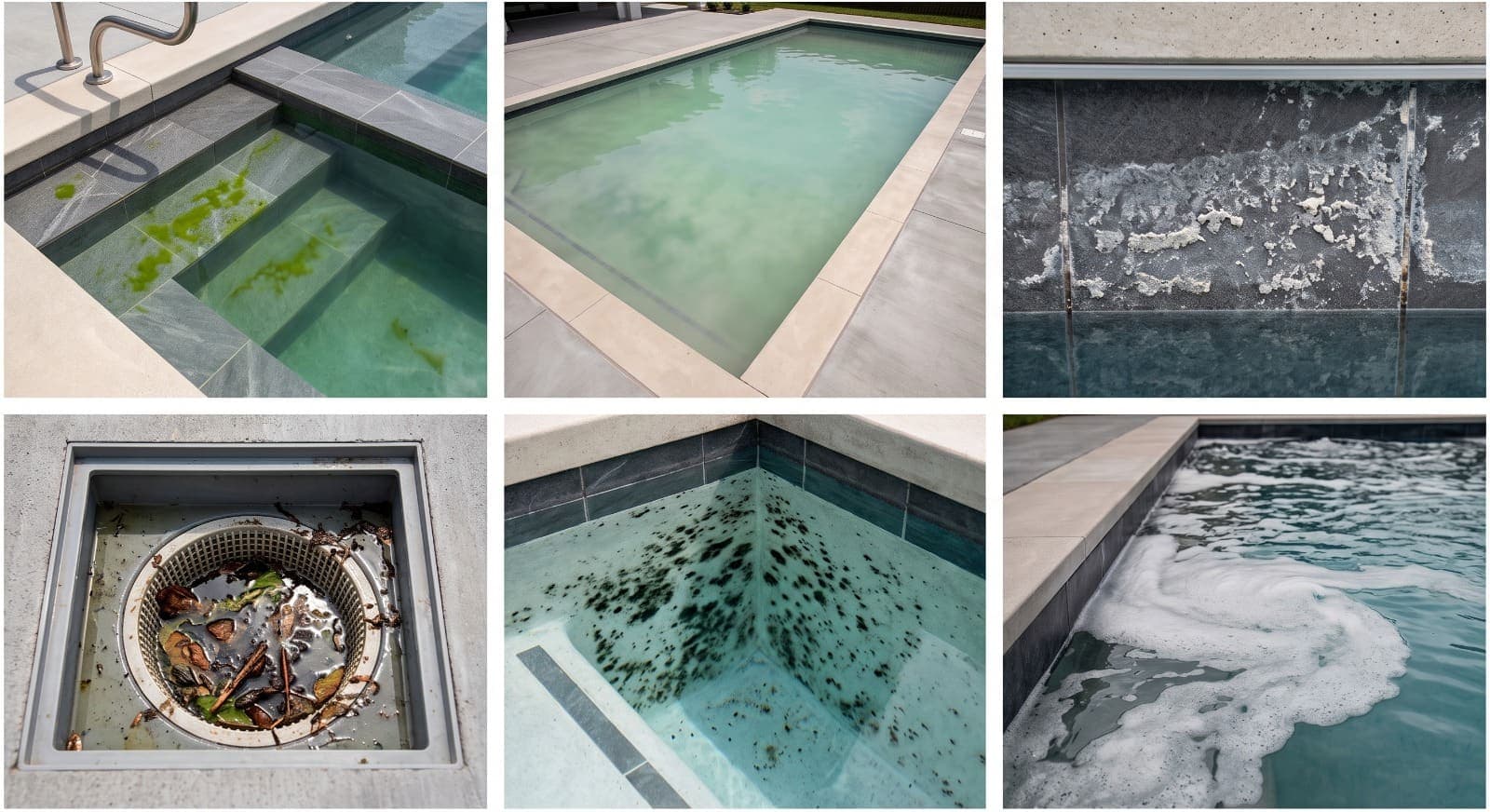
Every one of these started as a number that drifted. By the time a pool looks like this the chemistry has been out of range for days, and the fix costs more than the test that would have caught it.
Green water, or green streaks on the steps
Algae only grows where there is not enough free chlorine to kill it. Sunlight is usually the reason the chlorine went: without stabiliser, a hot afternoon can strip most of it in a day.
Free Chlorine →Cloudy or milky water
Fine particles the filter is not catching, often with pH and calcium hardness pushed high enough that the water is dropping them out of solution. It clears when the chemistry does, not when you add more chlorine.
pH →White crust along the waterline
Calcium coming out of the water and onto the tile. Scale is the direction water takes when it is over-saturated, and it lands on the heater long before it is visible on the tile.
Calcium Hardness →Black spots that brush off and come back
Black algae roots into plaster and grout, which is why it survives a normal chlorine level. It is the one form that needs the surface broken before shocking, not just a higher reading.
Free Chlorine →Foam on the surface
Dissolved solids and surfactants build up over a season of top-ups, sunscreen and body oils. Chemistry cannot remove them; only draining and refilling part of the water does.
Total Dissolved Solids →A skimmer basket full of debris
Organic matter is chlorine demand sitting in the water. Leaves left in the basket consume the sanitiser you paid for, which is how a pool that tested fine on Friday is green on Monday.
Total Chlorine →
Parameters
- Free Chlorine1 – 4 mg/LThe active, available chlorine actually disinfecting your pool, the single most important number for swimmer safety.
- pH7.2 – 7.8 pHHow acidic or basic the water is. It decides how well your chlorine works and how the water treats your equipment.
- Total Alkalinity60 – 180 mg/LThe water's resistance to pH change. Get this right and pH stops fighting you.
- Calcium Hardness80 – 400 mg/LHow much dissolved calcium the water holds, the difference between water that scales and water that dissolves your pool.
- Stabiliser (Cyanuric Acid)30 – 100 mg/LSunscreen for your chlorine. Too little and the sun destroys it; too much and it stops working.
- Salt (Saltwater Pools)2700 – 3400 ppmThe salt a chlorine generator converts into chlorine. Relevant only if you have one.
- Total Dissolved Solids0 – 1500 mg/LEverything dissolved in the water added together. A slow-moving indicator that the water is getting tired.
- Biguanide (PHMB)30 – 50 mg/LThe sanitizer in a chlorine-free pool. Nothing in a standard test kit can see it.
- Oxidizer (Hydrogen Peroxide)The second half of a biguanide system. Sanitizing and oxidising are two jobs, and biguanide only does one of them.
- ORP (Oxidation-Reduction Potential)650 – 800 mVNot how much sanitizer is in the water, but how fast it is actually working.
- CopperA sanitizing metal in mineral systems, and a staining problem everywhere else.
- PhosphateAlgae food. Not a health reading, and there is no published level a pool has to meet.
- IronA staining metal, usually from fill water or corroding equipment. Judged by eye more than by band.
- Total ChlorineEvery bit of chlorine in the water, working or spent. On its own it is not a verdict — its job is to reveal the part that is spent.
- Combined Chlorine0 – 0.4 mg/LThe spent chlorine that smells like chlorine. Worked out from your total and free readings rather than measured.
- Total Bromine3 – 8 mg/LThe sanitiser most hot tubs use instead of chlorine, and the one number that says whether the water is safe to sit in.
- Total Hardness80 – 400 mg/LWhat nearly every test strip actually prints. Calcium plus magnesium, where the published pool bands are written for the calcium alone.
- Water Temperature≤ 104 °FNot a chemical, and an input to almost every other number here. Also the one figure with a hard published ceiling.
- Salt Cell OutputThe dial on a salt chlorine generator. A setting rather than a measurement, and worth recording because of how it moves.
- Filter PressureThe gauge on the filter, read as a rise above whatever your own filter shows when it is clean.
- Carbonate AlkalinityTotal alkalinity with the stabiliser's contribution taken back out. Not a verdict of its own — the figure the saturation index is supposed to use.
- Saturation Index (LSI)-0.3 – 0.3 indexOne number for whether the water will scale your equipment or dissolve your pool. Calculated from five readings you already take.